Category: Wellness

  • It’s Never Too Late

    It’s Never Too Late

    “It is never too late to be what you might have been,” George Eliot.TFM Favorite Quote It'sNeverTooLate with tfm

    It’s never too late. If you’ve been following Two Fit Moms since we launched our website, you know that this is our mantra.

    We are committed to inspiring everyone — but especially moms, like us, that it’s never too late to be your best self. Regardless of your age, you can achieve your fitness goals, your career goals, your life goals.  You can change direction at any time and realize your potential.

    This motto is one that can be applied to many aspects of life.  And, we think it’s worth repeating.

    Remember. It’s never too late to be your best self.  It’s never too late to be fit. It’s never too late to achieve your wellness goals.

    Has this quote inspired you too?  If so, let us know how.


  • The Power of Positive Affirmations

    The Power of Positive Affirmations

    “Start training like an athlete. Start eating like an athlete. Start sleeping like an athlete.”

    One of my favorite fitness trainers gives this simple, yet very inspiring advice on an exercise DVD that I own. I can hear these words in my head, long after I’ve finished my workout.

    At the heart of this message is the idea that if you play the part, you will ultimately become the part. Maybe you’re not an athlete today, but by adopting the lifestyle of an athlete, you slowly but surely become one.Differently sized and colored pebbles, stacked

    Positive affirmations work in the same way. By repeating a motivational phrase and speaking positively, you can transform your habits and attitude over time.

    Just as the fitness trainer encourages her viewers to start living the life of an athlete, a positive affirmations practice can help you speak your dreams into existence. You can create the reality that you desire. By repeating positive affirmations each day, you effectively drown out the internal voices that say you’re too sick, too old, too injured, too heavy, too fill-in-the-blank. Your words have incredible power, so use that power wisely.

    Affirmations and Yoga
    If you would like to incorporate positive affirmations into your yoga practice, I recommend stating an affirmation (out loud or in your mind) every time you do a repetitive action.

    For example, you can state an affirmation every time you complete a round of sun salutations. Or you can state an affirmation every time you find yourself in downward facing dog or in mountain pose. Repetition is key. In order for the affirmation to be engrained into the subconscious mind, you must hear it often to truly internalize it.

    Here are two basic guidelines to follow when creating your own affirmations: First, keep your affirmation brief so that it’s easy to say and repeat. Here are a few that come to mind: I am strong. I am healthy. I am loved. I am successful. I am enough.

    Second, state your affirmation as if it is already true. Speak in the present tense rather than in the future tense. Rather than saying, “I will lose weight and get healthy,” say “I radiate health and wellness.” And rather than saying “I will find a better job and make more money,” say “I attract wealth and opportunity.”

    Feel free to create your own affirmations that speak to your spirit, and let us know how you do when you incorporate these positive statements into a yoga practice.  You WILL get over the discomfort of speaking positively about yourself.  I know it’s uncomfortable at first, but watch your life transform as you make the mind-body connection.


  • The Key to Managing Acute Stress

    The Key to Managing Acute Stress

    These days, most articles that I run across on the topic of stress tend to be about chronic stress— the day-to-day stress of jobs, finances and family dysfunction that chip away at our well-being, year after year. This is the insidious form of stress that we all try to manage with yoga and meditation in the hope that we can gain control over it and avoid all sorts of medical issues down the road (heart attack, stroke, ulcer, etc.) Controlling chronic stress is one of my on-going goals, and I use various techniques, such as journaling, prayer, and meditation to help each day.ManagingStress

    With all of this stress management on my mind, you’d think that I would be mindful of acute stress as well as chronic stress, but I actually rarely think about the acute variety. I lump all forms of stress into one bucket, and that’s not really a fair way to think about it.

    Acute stress is short-term stress that fires up in response to an event. The event might be a near collision on the highway. Or maybe something more primitive— like being chased by an animal. In either scenario, your stress hormones are in high gear. Your adrenal glands release adrenaline and norepinephrine, your heart races in your chest, and your body feels hyper-alert and energized.

    I thought about acute stress today as I was on a conference call for work. As I tried to speak naturally and (hopefully) intelligently, I worried that I was rambling and not communicating effectively. I suddenly realized that I was sweating and my heart was pounding in my throat as I was asked a series of interview questions. I was exhibiting the symptoms of an acute stress response!

    I wasn’t running from an animal or avoiding a near-death experience, but I was pumped up with stress hormones as if my life were in danger. Although the physical sensations of acute stress are uncomfortable, this type of stress response (in small doses) is actually good! We want our impulses to quicken and our awareness of our surroundings to intensify when we are in a challenging situation. What we DON’T want is uncontrollable energy and fear that cannot be used to our advantage. The good news is that we can effectively manage our acute stress to work for us rather than against us.

    Being able to channel the rush of adrenaline into a controlled stream of positive energy is the trick to being able to thrive under short-term stress. And you can do it!

    I know this isn’t going to come as a huge surprise, being that this is a yoga website and all…but the trick to managing and channeling this stress is to control the breath.

    You can turn an intense, harried situation into a calm, collected experience by slowing your rate of breathing. You will continue to benefit from the added burst of energy provided by the stress hormones flowing through your body, but you will be in full control. Your voice will not waver, and your actions will exude confidence.

    You obviously cannot shut down in the middle of your stressful episode to meditate or start flowing on your yoga mat. Instead, you will practice these two breathing techniques and re-gain control of the situation. You may find that one technique is easier than the other. Try them both for a couple of minutes each and see what works for you.

    Slow-Deep Breathing
    Inhale deeply through the nose for a count of six until the lungs are full, and then exhale through the nose for a count of six until the lungs are empty. In your head, count like this: Inhale-two-three-four-five-six; Exhale-two-three-four-five-six. Keep the count in your head for a couple of rounds until the rhythm of the slow breathing exercise feels natural.

    Square Breathing
    Inhale through the nose for a count of four; Hold your breath (with lungs full of air) for a count of four; Exhale for a count of four; Hold your breath (with lungs empty) for a count of four. Practice this breathing technique by maintaining this count in your head: Inhale-two-three-four; Hold-two-three-four; Exhale-two-three-four; Hold-two-three-four.


  • Taking Care of You

    Taking Care of You

    Recently, I had the opportunity to work with a life coach. It’s an interesting concept. Most people have probably never considered the idea of getting a life coach, but in theory, I guess it makes a reasonable amount of sense. All elite athletes have a coach to help them train. A coach can see things in you that you are unable to see in yourself and therefore, they are able to direct you toward the best path for success.

    Unlike a therapy session or a counseling session, which delves into your past to understand the present, life coaching analyzes the present in order to help bring positive change to your future.TakingCare

    At the end of my coaching session, I felt like I had been shown my own reflection, and that reflection wasn’t muddled or distorted. It was a perfect mirror, and I was able to see my own life with a level of clarity that I hadn’t seen prior to the session.

    I didn’t receive bucket loads of advice from this coach. In fact, I think good coaches rarely tell you what to do— they illuminate the way so that YOU know exactly what to do and can make those important decisions yourself. This particular coach did happen to give me a piece of advice, and I’m so happy that she did. It’s such a great piece of advice that I’m going to pass it on to you. It sounds obvious, but it’s not as simple as it sounds. Are you ready? Here goes:

    Do something for yourself every single day.

    Did you get that? You probably think you do, and maybe you do. I thought I got it, but I didn’t.

    I said to the coach, “I always do things for myself! I wake up at the crack of dawn each day and exercise, just for ME! I stay up late preparing healthy meals for the next day. That’s also for ME! I practice yoga to balance all of my strength training and to stay limber. And I even meditate every night! Trust me, I’m doing lots of things for myself.  I’ve got this concept down pat.”

    The coach listened. We then discussed each of the items that I rattled off my list. After talking for quite a while, I came to understand that everything that I did each day for myself was out of obligation, not pleasure. The coach’s intention behind her suggestion to do something for myself every single day was based on pure pleasure.

    Yes, I happen to enjoy my daily wellness habits, but I’m not doing any of those items for pleasure. I exercise, meditate, stretch and cook for hours to maintain good health and to avoid painful flare-ups. I do them religiously because I value my health and partly because I fear the pain and immobility that accompanies an autoimmune flare-up.

    So now…. Time to re-evaluate. Do I do something for myself every single day? Purely for pleasure? Probably not. I am ready to make this change. Are you? It doesn’t have to be an hour-long activity. It can even be 15 minutes. What do you love? Maybe it’s a cup of tea at a favorite café. Maybe it’s a bath at night. Maybe it’s a bike ride or a half hour with a magazine or good novel. Whatever it is, let it be something with no strings attached. No guilt attached.

    Do it for your well-being. Do it as a daily ritual to honor yourself.

    Please share what you plan on doing each day in the comments section below!

  • My Favorite Meditation App:  Alleviate Stress in Ten Minutes

    My Favorite Meditation App: Alleviate Stress in Ten Minutes

    Yesterday was quite a day. Stressful and intense are two words that come to mind when I think about it. I admitted my daughter to the hospital for an overnight treatment to help fight a nasty virus in her newly transplanted kidney.

    As I packed my bag for the trip, I assured myself that everything would be fine, and my daughter wouldn’t be too upset about this hospitalization.

    We’ve done this before, I thought. I am fine with going back to the hospital. We know so many of the nurses and can navigate that children’s hospital like pros. It’s just a one-night stay. We’ve had to stay for weeks in the past. One night is nothing. She won’t mind. We will make it as enjoyable as possible. We will play Candy Crush and watch a movie together and make the best of a crappy situation.Yoga girl in lotus position ,abstract frame

    Well, I must have been in denial. My daughter was horrified to learn that we would have to stay overnight. The last time she was admitted to the hospital, she endured weeks of painful, extensive treatments and tests. Coming back to the same hospital and being re-admitted must have triggered terrible memories. It was tough for me to see her so upset.

    I was in for a huge shock when it dawned on me that this hospitalization was hard for me, too. I really thought it would be fairly easy to handle, but I found it to be sweat inducing, nerve wracking, frustrating and downright difficult. It was nearly 11 pm when the treatment finally began, and I was completely spent. We hadn’t yet started the movie that we planned to watch, we hadn’t gone to the gift shop to buy bags of popcorn, and we hadn’t done anything that we had intended to do to make the hospital stay a bit easier. I was sprawled on the rollaway cot in the hospital room, and I didn’t even have the energy to walk to the bathroom. Every inch of my body was exhausted, and my brain felt like it stopped functioning. I’m not sure why it suddenly crossed my mind to meditate right then and there, but that’s exactly what I did. I didn’t have the energy to sit up. I didn’t even have the energy to clear my mind on my own.

    But I did find the energy to pull my iphone out of my pocket and open the Headspace app. I listened to a free 10-minute guided meditation, and when it was over, I opened my eyes, and I was completely rejuvenated. I felt like I had slept for hours. I’ve NEVER experienced anything like that before. I’ve heard that meditation is quite powerful and can have a restful effect on the body, but I have never personally experienced such rejuvenation after 10 minutes of anything!

    I guess there’s a first time for everything, and I’m thankful that this particular first time happened to occur during this stressful experience at the hospital. It probably helped that this wasn’t my first time meditating, and it probably also helped that I had a daily meditation practice— but I’ve only been meditating on a regular basis for about two and half months. If I can create a successful meditation experience that is both restful and rejuvenating with just a couple of months of practice, I know you can, too. If you are interested in creating a regular meditation practice, begin by reading some of my tips for getting started. Then, go ahead and download the Headspace app. Give the 10-day program a try. It’s not overwhelming, and I know you have 10 minutes to spare.

    Please note that I do not work for Headspace, I am not paid by Headspace. I do not benefit in any way by telling you about this Headspace app. This is just part of my personal journey, and I want to share whatever happens to be working for me.

    Here’s a quick summary of what I’ve discovered so far (which isn’t a lot because I’ve only recently started using it):

    Headspace is an app that offers you the basics of meditation in a free 10-day program called Take10. Each day, you listen to a 10-minute guided meditation. It’s simple. You put your headphones on and tune into the instructor’s voice for ten minutes. You don’t have to think about setting a timer or finding background music or wondering if you can tune into your breath. The instructor tells you exactly what to do, and that’s what makes it so easy. It takes all of the thinking out of the process, which is exactly what you need as a beginner.

    If you give the app a try, please leave a comment and let me know! Share your journey with us!


  • Why I Gave Up Moderation

    Why I Gave Up Moderation

    I’ve been debating whether or not I should write an article about this topic for quite a while because it’s a bit controversial, but this morning, I finally decided that it was time. None of this may resonate with you, and that’s ok. I am posting these thoughts because they might be helpful in analyzing your own wellness journey, and they might even encourage you to change your current approach.

    As the title of this article suggests, I’m not one to tout the “everything-in-moderation” mantra. I’ve come to the realization in recent years that the concept of moderation just doesn’t work for me.Moderation

    Let me start at the end, rather than at the beginning: What I have discovered over the past few years is that a wellness journey is very specific to each individual. There is no one-size-fits-all approach. What works for one person will not necessarily work for another. I have experimented and tweaked habits and tried various techniques to find the wellness path that works best for me, and my ultimate conclusion is that my personality just doesn’t allow for moderation. Rather than fighting this realization, I have embraced it. And I assure you that traveling along a healthy path is easiest when you are fully in tune with who you are as a person— your habits, tendencies, and overall personality.

    Let me tell you a quick story.

    The other day, I was talking to Kate (our Director of Marketing), and she told me about her former colleague who would open a small bag of pretzels each day at her desk for a mid-day snack. Rather than devouring the entire bag (that’s my style), she would eat a few, and then re-seal the bag with a clip for the next day’s snack.

    I just stared at Kate in silence. Cue the crickets. Who was this woman? She must be the poster child for moderation! Incredible! How did she eat five mini pretzels and save the rest for later? She was capable of snacking moderately and moving on with her life? How?!! I’ve run across people like this, and it baffles my mind. My own husband has a very similar personality. He can take one bite of a cookie and say, “That was delicious. I’ve had enough.” My personality would never allow for such behavior.

    Let me illustrate my own scenario in the same office setting: I would open a bag of pretzels, eat five, and close the bag with a clip in an attempt to practice moderation. Then, I would return to my work. Rather than concentrating on my work, I would sit and obsess about the remaining pretzels even if I wasn’t particularly hungry. After wasting a reasonable amount of time trying to show restraint, I would re-open the bag of pretzels and finish them all.

    Why is it that Kate’s colleague can snack on a few pretzels, and I cannot? Do I lack discipline? No, it’s not that. I have a tremendous amount of discipline. For years, I willed my body out of bed at 5 am each day to hit the gym, even if I went to bed at midnight. I’ve pulled all-nighters to study. I’ve committed myself to strict healing diets in the past to heal from inflammatory conditions. I definitely have discipline. BUT, what I see now is that practicing moderation has nothing to do with discipline!

    I am an all or nothing kind of girl. For me, it’s easier to skip the pretzels altogether or to eat them all in one sitting. It’s more of a challenge to eat a few today and then to try and eat a few each day going forward. Moderation is tortuous for me.

    I don’t buy candy and cookies and junk food for my house because I can’t just eat one cookie. It’s MUCH easier for me to not have any cookies in sight. Without cookies in my pantry, I don’t even think about them! There is no struggle. When I do want a fabulous dessert, I go to a restaurant and have one. I eat it with great enjoyment, and then I continue on with my life. There are no fabulous desserts in my pantry. All or nothing works for me. Eating junk food on a daily basis in moderation doesn’t.

    Today, take a few moments to analyze your own personality. Does your personality allow for moderation? If so, carry on. If you have more of an all-or-nothing personality, don’t fret. Work with your strengths by creating routines. I think I thrive so much on my morning routine because my personality craves the structure and discipline. I don’t leave it up to fate to decide whether I will have a bite of a doughnut for breakfast. My weekday breakfasts are non-negotiable. I plan them in advance, and that’s it! I don’t even have to make a choice to practice moderation because I’ve created habits that work for my everyday life. It works for me and keeps me happily moving down Wellness Lane. I am not sure if it will work for you. It all depends on your own personality. Either way, it’s food for thought. Thanks for reading.


  • 3 Tips to Increase Your Productivity

    3 Tips to Increase Your Productivity

    Some days, I feel like I work, move and hustle continuously, but when I finally get into bed at night and mentally review what I’ve accomplished, I have nothing to show for it. I know I’m not lazy, and I know I’ve been sitting at my desk working, so where did I lose all of my precious hours of productivity? Well, this is a bit embarrassing to admit, but I think I know the answer. My hours were lost to my iPhone.Productivity

    I don’t mean that I surf the web for hours or get caught up in video games. Not even close. I probably don’t even spend more than 10-15 minutes at a time on my phone, but I’ve found that even a 30-second break to respond to a text, to mindlessly scroll through photos, or to check for new e-mails is long enough to break my concentration. Once the concentration is broken, it’s a process to re-immerse myself into my work.

    Here’s a quick illustration of this point:

    As an experiment, I placed my phone, face up, right next to me on the table as I began to write this post. After 40 minutes, I assessed my productivity. I wrote ONE paragraph. FORTY minutes to write four sentences! Geez…Yes, I happen to be a slow writer, but I’m not that slow.

    The problem with having my iPhone next to me at all times is that it is a constant distraction—even after minimizing what I thought were the obvious distractions.

    Let’s take a look at my current efforts to minimize phone distractions:

    -My phone settings are configured so that all social media notifications are turned off.

    -My text message notifications are on, but they are completely silent as they flash across my phone screen.

    -Even my phone’s ringer is turned to silent mode and only buzzes for incoming calls.

    Despite this effort, my phone still affects my productivity.

    Here’s what happened during the 40 minutes that I was supposedly writing:

    -I received 21 text messages and read all of them as they arrived.

    -I responded to 4 of those messages.

    -I checked my e-mail once.

    -I checked my notification feed on Facebook once.

    Each item on the above list probably took less than two to three minutes to address, but the end effect was not just a loss of two to three minutes of productivity.

    The smart phone is such an amazing feat of technology, allowing me to travel and work and stay connected at all times, but it is a double-edged sword. This small device that acts as my phone, mini-computer, family photo album, public library, television, instant messaging service, etc, constantly calls for my attention and gives me the constant stream of information and stimulation that I crave. And of course, the more I give in, the more I crave additional information and stimulation. (Hence, the constant checking of the phone.)

    I know I can’t be alone in this experience, and I know I can’t be the only one that is fed up with disappointing days of low productivity.

    Here’s an idea: Let’s reclaim our days and be more effective with the time that we are given. This is my latest challenge to bring an increased sense of peace and mental clarity to my life. I hope you will join me! In an effort to limit distractions and maximize effectiveness and productivity, I will implement the following three changes in my life:

    Reduce Frequency of E-mail Sessions to Three Times Daily
    No more frequent e-mail checks through out the day. I am in the bad habit of turning to my inbox all day long—when I am bored, having writer’s block, waiting for a document to print, etc. Instead of continuing with this disruptive activity, I will set aside three specific times during the work day (no less than four hours apart) to check e-mail. While I respond to e-mail, I will focus on that task for no more than 30 minutes. At the end of 30 minutes, I will close my mail until the next allotted time.

    Disable All Notifications on Phone
    I will turn off ALL notifications on my phone— including text message notifications. Going forward, I will only check text messages during my planned breaks. The only interruption that will be allowed is the ring or vibration for incoming phone calls. I will not worry about urgent texts—there’s no such thing. If there is a true emergency, someone will pick up the phone and call me.

    Treat Social Media as a Hobby
    Think about your hobbies. Think about what they are and when you participate. No one pulls out a sewing machine to sew for ten minutes every hour. No one stops working to play tennis for ten minutes every hour. As a hobby, there is a special block of time set aside to enjoy it fully. To work well in my life, I think that social media needs to be compartmentalized, just like a hobby. I don’t want to whittle away at my potentially productive blocks of time with a few minutes of mindless scrolling every half hour. Instead, I will set aside two periods of time each day to connect with friends and family on my personal social media accounts. No more three-minute Facebook breaks that disrupt the work flow. I’m done with that. If social media is going to be a hobby, it’s going to be treated like a hobby.

  • 10 Ways to Prepare for a Healthy Morning

    10 Ways to Prepare for a Healthy Morning

    We all know how difficult it is to break a bad habit. Fortunately, breaking a good habit is just as difficult. Once a habit is engrained, it becomes part of daily life. Just think about your daily routine. You probably step out of bed and walk directly to the bathroom where you brush your teeth, even if you don’t feel like it. This habit of brushing your teeth doesn’t require much thought or stress. It’s automated. By automating a task, it becomes non-negotiable, and it gets done.

    In my own life, I have automated a series of healthy tasks so that they feel like a natural part of my life. Every morning, I make my way through my morning routine without feelings of stress or dread.HealthyMorningBanner

    If you are looking to adopt a healthy set of habits to create a new morning routine, you must find a way to automate these tasks so that they get done each day without a second thought. When I say “automate”, I don’t mean that you become a robot and mentally check out. I mean you get up and do these things without a mental debate of “should I” or “shouldn’t I”. You just do it.

    A few days ago, I wrote an article discussing how much I love my morning routine. The routine doesn’t magically happen without planning and effort though. It takes a bit of preparation. I’ve found that the easiest way to get a routine to the point of automation is to prepare as much as possible in advance. Prepping doesn’t guarantee success, but it certainly increases the odds.

    In order to help you, I’ve compiled a list of suggestions to help you prepare for your morning as much as possible. These are all tips that I’ve used in my own life. By taking some of these steps to start your morning routine the night before, you are much more likely to complete the routine when you get up. Feel free to incorporate as many of these suggestions as you’d like into your own life. You can do it!

    1.  For a portable, nutritious breakfast, pre-load your blender with fruits and vegetables before bed each night so that in the morning, you just have to add your liquid and blend a smoothie.

    2.  Use a multi-compartment pill case to set aside all of your vitamins and supplements for each day of the week. Allocate a little time, and sort your pills for the week. You’d be surprised how much time you can spend unscrewing childproof caps and getting your supplements ready every single morning.

    3.  Set out all of your exercise clothing the night before, including your socks and sneakers.

    4.   If you work out at home or practice yoga at home, set up all of your equipment before going to bed. Roll out your yoga mat, place your blocks at the top of the mat, make sure your strap is within reach, and a towel, too.

    5.  If you work out at a gym (or a studio), pack your bag and set it by the door. I remember the days of hitting the gym at 5:30 am. My brain was barely awake at that hour. If you are planning to shower at the gym and go directly to the office afterwards, I highly suggest that you wear your work clothes (NOT your exercise clothes) to the gym in the morning. Pack your exercise clothing in your gym bag. I used to think that I was saving myself lots of time by wearing my workout gear to the gym, but on many occasions, I found myself standing in the locker room after my workout without a vital piece of clothing. Once, I packed a full suit with stockings and heels, but I forgot to pack a shirt. Total disaster. At the end of the day, you’ve got to do what works best for YOU—even if it takes a bit longer.

    6.  Try a recipe for one of our make-ahead breakfasts! Oatmeal cake is one of my favorites. I don’t even bother re-heating it because I love eating it right out of the refrigerator.

    7.  Wash and chop frequently used fruits and vegetables, and store them in a container with a paper towel to absorb moisture in your fridge. Prepping any meal becomes much easier when the ingredients are ready to use.

    8. Plan your drinks in advance. Do you want to start the day with a glass of water with lemon? If so, wash and slice your lemon and keep the wedges in a glass container in the fridge. Do you plan on taking your drink with you as you commute? If that’s the plan, make sure that your re-usable water bottle is clean and waiting for you on your kitchen counter.

    9.  If you have kids that need to get out the door for school, set the breakfast table the night before. Silverware, plates, napkins, placemats, cups, etc. Cutting out the small tasks in the morning leaves time for other things.

    10.  If your children need packed snacks and lunch boxes for school, do as much of the packing as possible the night before. Make sure napkins, water bottles, plastic spoons/forks and sandwich containers are washed and ready to go. Pack everything non-perishable in advance (i.e., apple sauce, crackers, drinks). In the morning, you only need to add your refrigerated items, and you will feel less rushed.


  • The Secret to Developing & Maintaining a Healthy Morning Routine

    The Secret to Developing & Maintaining a Healthy Morning Routine

    A couple of days ago, I posted a photo on my Instagram account along with a caption about morning routines. My morning routine is so important to me— it sets the tone for my day. If I wake up late, my routine is destroyed, and I never seem to fully recover from it. Everything just feels off for the remainder of the day. BUT, if I wake up on time and get through my morning tasks, I feel accomplished and ready to take on the world.

    Lately, I’ve been thinking a lot about my morning habits. I’m not sure why I’m suddenly so intrigued by my own daily routines as well as the routines of others. Maybe I find it so interesting because we are all creatures of habit, and we do so many of the same tasks over and over. Mug of Tea and Newspapers with Sunglasses on Table
    Think about your own daily routine, and you’ll be shocked by how many of the same things you did yesterday. Given that there is so much repetition in our lives, doesn’t it make sense that the tasks that we repeat should bring us joy and health and a sense of accomplishment?

    As you assess your own routine, ask yourself if you are happy with your habits. Do they reflect the actions of the person you want to be? If not, don’t worry. You can create new habits, starting with a morning routine that makes you feel proud and healthy. It’s not as difficult as you may think. I’ll teach you the secret to create a long-lasting, healthy morning routine.

    Let’s start by taking a look at my own routine. Here is what I did this morning:

    1. I opened my eyes at 5:45 am.

    2. Brushed my teeth, washed my face, put my hair in a ponytail.

    3. Put on exercise clothing.

    4. Went to the kitchen and poured myself a glass of room temperature water and squeezed a lemon wedge into it.

    5. Turned on a 30-minute exercise DVD at 6 am.

    6. Lifted weights at 6:30 am.

    7. At 7 am, I poured myself another glass of water and took my pre-breakfast supplements.

    8. Packed a lunchbox for my son.

    9. At 7:15 am, I went upstairs, woke the kids, and helped pick out my son’s clothes.

    10. Headed back down to the kitchen and made pancakes with fruit for the kids.

    11. Served the kids breakfast at 7:40 am.

    12. While the kids ate, I steamed my kale, heated my vegetable soup, and dissolved my miso paste in a cup of water.

    13. Sat down with the kids around 7:50 am to eat my own breakfast.

    14. At 8:10 am, I measured all of my daughter’s medications and used the opportunity to take the rest of my supplements.

    15. At 8:20 am, I sent my son off to school and told my daughter to bring her homeschooling books down to the dining room to work. As she did that, I went to my bedroom to get changed for the day.

    Assessing the list
    There are 15 items on today’s list. Guess how many items were on yesterday morning’s list? That’s right. 15. Sure, the kids’ breakfast might be a bit different from day to day, and the exercise DVD may change, but for the most part, I did the exact same things! Who knew I was such a creature of habit?

    I found myself wondering why I do all of these things, and how I managed to convince myself to do all of these things each morning. The answer to the “why” portion of the question is quite simple. These tasks keep me feeling healthy, motivated and accomplished. And the answer to the “how” part of the question? Preparation. I cannot stress this enough. Preparation is the secret to creating such habits.

    Preparation is the answer.
    I cannot wake up in the morning and make pancakes (from scratch) for my kids and then also manage to make my steamed kale and a pot of fresh miso soup, too. It’s just not happening. But with a bit of preparation the night before, it’s possible.

    Last night before going to bed, I mixed all of my dry pancake ingredients in one bowl and left it on my counter. I mixed all of my wet ingredients into another bowl and put that bowl into my fridge. This morning, I mixed the two bowls of ingredients together and had pancakes on the table in less than 10 minutes.

    Without preparation, brown rice-flaxseed pancakes on a weekday morning would be impossible. WITH preparation, the pancakes are guaranteed. If you prepare the batter ahead of time, you will not fail to produce the pancakes. Do you see the beauty in that statement?

    Preparation guarantees action, or at least increases the probability of success. This is why I take the time to make a big pot of vegetable soup on the weekends. I want to increase the probability that I will start my day with vegetables. It’s also why I wash and chop my greens as soon as I get home from the supermarket. I always have piles of kale or collards that are ready to be thrown into the steamer or into the blender for a smoothie.

    You may already have a morning routine in place that you love! If so, keep on grooving. If not, start making a list of habits that you’d like to adopt. Keep in mind, your list is your own — you may have 15 items on it like mine, or perhaps seven or eight.  Embrace your list and your routine, and start generating a plan for how you will make this wish list of habits a daily reality. By planning and preparing, you will greatly increase your probability of success. Good luck!

  • Every Day Matters; Everyday Matters

    Every Day Matters; Everyday Matters

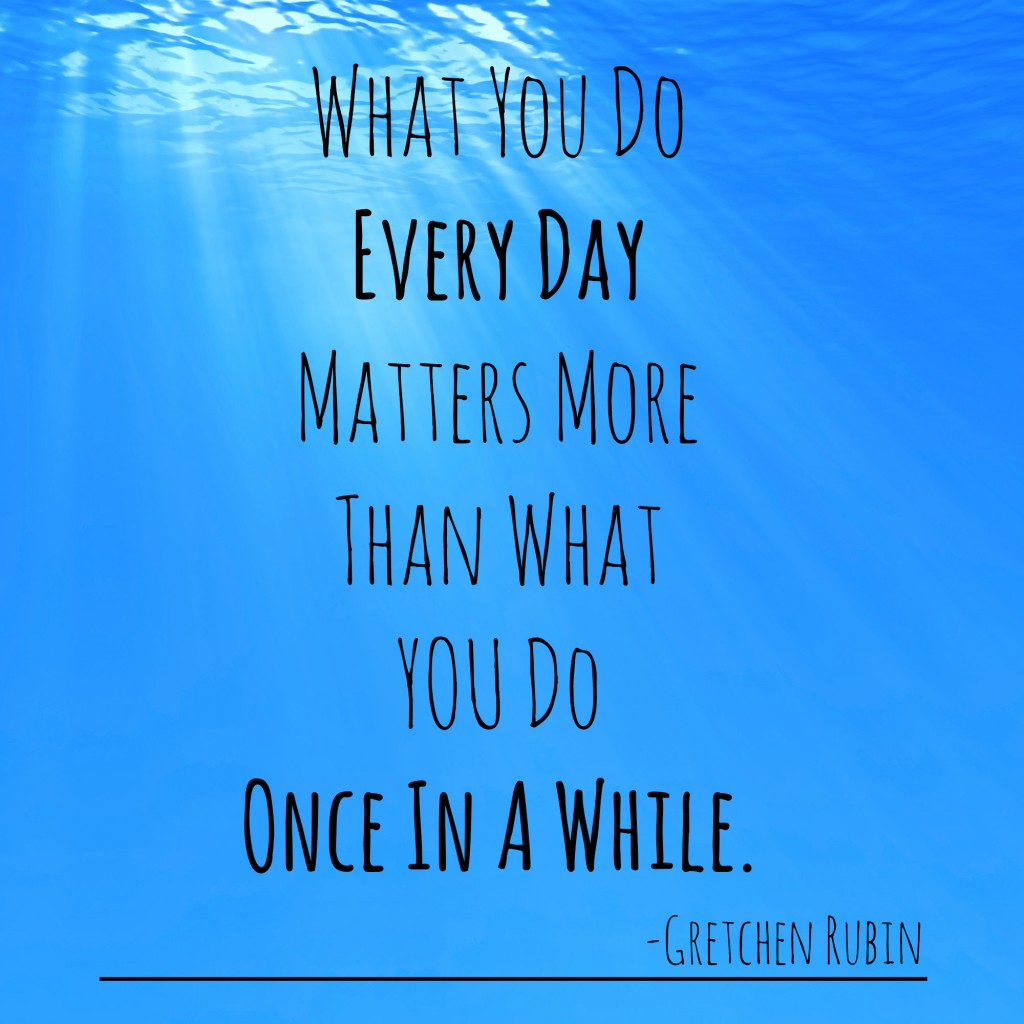
    “What you do every day matters more than what you do once in a while.” — Gretchen Rubin

    I found myself nodding in agreement this morning as I read this quote. The everyday habits (or at least the ones we do on a frequent basis) are what define us, not the occasional experiences.

    Think about this quote, and use it to assess your own life. Allow it to inspire you!

    What are YOU doing every day?

    Do your daily habits reflect the kind of life that you want to be living?

    Do your daily habits reflect who you think you are as a person?

    What changes can you implement in your life to become the person you have been envisioning all along?

    Today, I encourage you to find a few minutes to take stock of your life. Make a list of your frequent/daily activities. Are you prioritizing the important things? The hobbies that bring you joy? The people who matter most? The tasks that help you live the healthiest life you can live?

    EveryDay