Category: Latest News

  • Create Your Own 30-Minute Yoga Playlist

    Create Your Own 30-Minute Yoga Playlist

    After posting my article on structuring a 30-minute yoga practice, I decided that I couldn’t possibly leave you hanging without a plan for music. Not everyone wants or needs music to accompany their yoga poses, but if you’ve been racing around all day (like most of us), it’s not always easy to suddenly settle down and clear the mind for yoga. Music can help set the mood, help you focus on your breath, and then help set the pace for your practice.Vector illustration of yoga listening his heart, isolated on black background
    When I create playlists of any length, I make it a point to pick music that mirrors the ebb and flow of my practice. Like a wave, a yoga sequence builds, reaches a peak, and then dissipates into peacefulness. It’s important for the music to follow suit.

    If you randomly string together a collection of your favorite songs without giving thought to the mood and tempo provided by each selection, the flow of your postures will not match the flow of your playlist.

    Fortunately, a 30-minute playlist is fairly simple to organize because of its short length, and I recommend getting the hang of creating a 30-minute list before moving on to create a 60-minute list. If your songs are roughly five minutes long, you only need about six songs to create your own half-hour playlist.

    0:00 – 5:00 minutes
    During the first five minutes of my practice, I like to close my eyes, shut out the world, and focus on my breath. My mind races all day, and this is my opportunity to shut it down. After a few minutes, I open my eyes and do some light stretches. For this period of time, I make sure that I am playing instrumental music. I cannot tune into my inner voice if the bass is pounding or if I hear someone else’s voice singing in my head. I recently downloaded an amazing collection of music from Ben Wisch. The gentle sound of the piano is perfect for this part of my practice.

    5:00 – 10:00 minutes
    It’s time for sun salutations! Maybe the first time through, I am moving gingerly and stretching my tight muscles, but by the time I’m on my second round of sun salutations, I’m building heat and moving at a reasonable clip. I’m no longer interested in slow instrumental music. I want music that reflects the increased pace of movement. The song that you play during this time doesn’t have to be your quickest tempo, but it should signify that you are no longer sitting on the floor breathing deeply and stretching. I’ve been listening to music by Enigma for 20 years, and I’ve found a number of their songs to be the perfect pace for this part of my practice.

    10:00 – 20:00 minutes
    This window of time is the peak of the wave. I’m flowing continuously, and my muscles are stretching and working hard. In my opinion, it is perfectly appropriate to insert your favorite hip hop or dance music right into this part of your practice. There is a time and a place for everything. Do I recommend club music for a restorative or yin practice? Of course not. But for a heart-pumping, energizing flow… sure. Feel free to insert any genre of music that makes your spirit soar and your body happy. She Knows (J.Cole) and the Finally Moving remix (Pretty Lights) are two suggestions for you from one of my own 30-minute playlists.

    20:00 – 30:00 minutes
    During the final ten minutes of my practice, I like to sit on my mat and do a little floor work. Now that my muscles are warm, I can focus on a particular body part and hold each pose a bit longer. The pace is slower, even if the effort feels just as great.

    During this time, if my hips feel particularly tight, maybe I will practice lizard pose for a minute with my back knee down on the mat. Once I feel a bit looser, I might lift the back knee and spend another minute or two in lizard, rolling onto the outer edge of my foot and then back down onto the sole of my foot. After that, maybe I’ll sit in pigeon pose for a minute or two and then take a deep squat (Malasana Pose) to stretch the groin muscles and hips even more.

    The main idea here is that you are down on your mat, holding poses. You are no longer flowing. It’s time to slow the tempo of your playlist. You’ll notice that my playlist includes Wicked Games by Parra for Cuva and Fade Into You by Mazzy Star.

    With a 30-minute practice, I rarely include a savasana, but when I do have the time to spare, I just put my playlist on repeat mode and use the first song on my playlist to serve as the soundtrack for my savasana. I don’t mind hearing the same song twice— it reminds me that I’ve come full circle in my practice, and there is beauty in that. Lie back and enjoy a few moments of peace if you can.

    My 30-Minute Playlist

    Playlist

  • How to Structure a 30-Minute Yoga Practice

    How to Structure a 30-Minute Yoga Practice

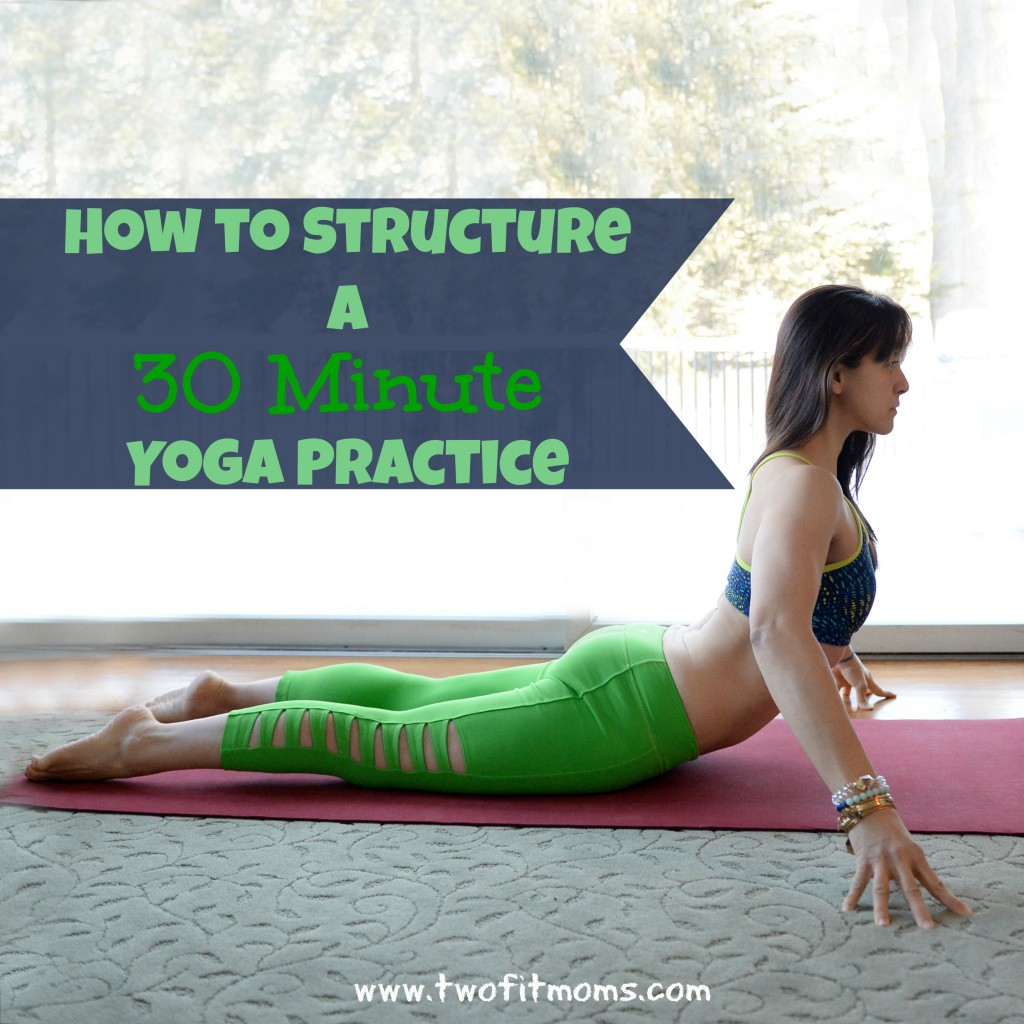
    I have a confession to make…On most days, I don’t flow for more than 30 minutes on my mat. Yes, of course, there are those special days when I can practice for hours without interruption, but most of the time, life calls, and I have to be perfectly content with a half hour of yoga. Fortunately for me, thirty minutes happens to be the magic number. I can get through my flow without sweating like a beast, and I can continue on with my life without having to shower. (This is actually a big deal for busy moms that are constantly on the go and feel pressed to find any time to exercise at all. Having to shower can be a deal breaker.)30MinYoga

    If you are considering an at-home practice, start with thirty minutes! It’s a minimal commitment of time, and you will feel really good at the end of it all. Your muscles will be happy, your mind will be clear, and you will get a good deal of satisfaction from knowing that you did something good for yourself.

    If you need a little help getting started, here’s how I would recommend structuring your practice:

    0:00 – 5:00 minutes
    Close your eyes, shut out the world, and begin to focus on your breath. Set an intention for your practice. Your intention doesn’t have to be particularly profound, but you certainly can go ahead and think about your purpose in life or your purpose for getting on your mat. Instead of an intention, you can state a few positive affirmations to uplift your spirit— For example—I am strong; I am healthy; I am enough.

    When you are ready, slowly open your eyes and spend a few minutes doing some light stretching. I like to reach my arms overhead and stretch the sides of my body. I also do some gentle seated twists, a few cat-cows, maybe some wrist and shoulder stretches, and a nice long downward facing dog.

    5:00 – 10:00 minutes
    I always include a few rounds of sun salutations at the start of my practice. During this time, I warm up my body, and I also manage to completely clear my mind by focusing on each inhale and exhale that accompanies every pose. The best thing about sun salutations is that they are so engrained into my memory that I can simply move without thinking. I’m not worried about what comes next because my body just knows. If you are not yet at the point where sun salutations flow naturally without much thought, don’t worry. You will get there. If you include the same Sun Salutation A sequence at the beginning of every flow, you will learn it very quickly.

    10:00 minutes – 20:00 minutes
    If you are designing your own flow, you need to be aware of how much time each pose will take to complete. This is up to you, and you can move as quickly or as slowly as you like, but my preference is to hold poses for about 30 seconds, or 5 full breaths. I am assuming that each full breath is about 6 seconds long (i.e., 3 seconds for your inhale; 3 seconds for your exhale). Following this simple math, a sequence that includes 10 poses will take you about 5 minutes to complete. And of course, if you are practicing the right and left sides of your body, your 5-minute sequence will actually be a 10-minute practice. For a quick 10-minute flow, check out our Yoga for Busy Moms sequence.

    20:00 minutes – 30:00 minutes
    At this point, assess how you feel. Some days, you might feel very energized and want to stay on your feet. If that’s the case, go ahead and repeat your 10-minute flow. Other days, you might want to do some floor work and stretch a specific body part. Go ahead and take a seat. Work on whatever body part is calling for attention. When your hips feel tight, sit for a few minutes in various pigeon pose variations. When your shoulders and chest feel tight, lie down across a block or practice other heart openers. Or maybe you choose to do 5 minutes of seated stretches and 5 minutes of inversions. The beauty of your at-home practice is that you can do whatever you want! Experiment, play, and enjoy yourself.

    Please feel free to tell us about your own home practice in the comments section!


  • 3 Tips to Increase Your Productivity

    3 Tips to Increase Your Productivity

    Some days, I feel like I work, move and hustle continuously, but when I finally get into bed at night and mentally review what I’ve accomplished, I have nothing to show for it. I know I’m not lazy, and I know I’ve been sitting at my desk working, so where did I lose all of my precious hours of productivity? Well, this is a bit embarrassing to admit, but I think I know the answer. My hours were lost to my iPhone.Productivity

    I don’t mean that I surf the web for hours or get caught up in video games. Not even close. I probably don’t even spend more than 10-15 minutes at a time on my phone, but I’ve found that even a 30-second break to respond to a text, to mindlessly scroll through photos, or to check for new e-mails is long enough to break my concentration. Once the concentration is broken, it’s a process to re-immerse myself into my work.

    Here’s a quick illustration of this point:

    As an experiment, I placed my phone, face up, right next to me on the table as I began to write this post. After 40 minutes, I assessed my productivity. I wrote ONE paragraph. FORTY minutes to write four sentences! Geez…Yes, I happen to be a slow writer, but I’m not that slow.

    The problem with having my iPhone next to me at all times is that it is a constant distraction—even after minimizing what I thought were the obvious distractions.

    Let’s take a look at my current efforts to minimize phone distractions:

    -My phone settings are configured so that all social media notifications are turned off.

    -My text message notifications are on, but they are completely silent as they flash across my phone screen.

    -Even my phone’s ringer is turned to silent mode and only buzzes for incoming calls.

    Despite this effort, my phone still affects my productivity.

    Here’s what happened during the 40 minutes that I was supposedly writing:

    -I received 21 text messages and read all of them as they arrived.

    -I responded to 4 of those messages.

    -I checked my e-mail once.

    -I checked my notification feed on Facebook once.

    Each item on the above list probably took less than two to three minutes to address, but the end effect was not just a loss of two to three minutes of productivity.

    The smart phone is such an amazing feat of technology, allowing me to travel and work and stay connected at all times, but it is a double-edged sword. This small device that acts as my phone, mini-computer, family photo album, public library, television, instant messaging service, etc, constantly calls for my attention and gives me the constant stream of information and stimulation that I crave. And of course, the more I give in, the more I crave additional information and stimulation. (Hence, the constant checking of the phone.)

    I know I can’t be alone in this experience, and I know I can’t be the only one that is fed up with disappointing days of low productivity.

    Here’s an idea: Let’s reclaim our days and be more effective with the time that we are given. This is my latest challenge to bring an increased sense of peace and mental clarity to my life. I hope you will join me! In an effort to limit distractions and maximize effectiveness and productivity, I will implement the following three changes in my life:

    Reduce Frequency of E-mail Sessions to Three Times Daily
    No more frequent e-mail checks through out the day. I am in the bad habit of turning to my inbox all day long—when I am bored, having writer’s block, waiting for a document to print, etc. Instead of continuing with this disruptive activity, I will set aside three specific times during the work day (no less than four hours apart) to check e-mail. While I respond to e-mail, I will focus on that task for no more than 30 minutes. At the end of 30 minutes, I will close my mail until the next allotted time.

    Disable All Notifications on Phone
    I will turn off ALL notifications on my phone— including text message notifications. Going forward, I will only check text messages during my planned breaks. The only interruption that will be allowed is the ring or vibration for incoming phone calls. I will not worry about urgent texts—there’s no such thing. If there is a true emergency, someone will pick up the phone and call me.

    Treat Social Media as a Hobby
    Think about your hobbies. Think about what they are and when you participate. No one pulls out a sewing machine to sew for ten minutes every hour. No one stops working to play tennis for ten minutes every hour. As a hobby, there is a special block of time set aside to enjoy it fully. To work well in my life, I think that social media needs to be compartmentalized, just like a hobby. I don’t want to whittle away at my potentially productive blocks of time with a few minutes of mindless scrolling every half hour. Instead, I will set aside two periods of time each day to connect with friends and family on my personal social media accounts. No more three-minute Facebook breaks that disrupt the work flow. I’m done with that. If social media is going to be a hobby, it’s going to be treated like a hobby.

  • 10 Ways to Prepare for a Healthy Morning

    10 Ways to Prepare for a Healthy Morning

    We all know how difficult it is to break a bad habit. Fortunately, breaking a good habit is just as difficult. Once a habit is engrained, it becomes part of daily life. Just think about your daily routine. You probably step out of bed and walk directly to the bathroom where you brush your teeth, even if you don’t feel like it. This habit of brushing your teeth doesn’t require much thought or stress. It’s automated. By automating a task, it becomes non-negotiable, and it gets done.

    In my own life, I have automated a series of healthy tasks so that they feel like a natural part of my life. Every morning, I make my way through my morning routine without feelings of stress or dread.HealthyMorningBanner

    If you are looking to adopt a healthy set of habits to create a new morning routine, you must find a way to automate these tasks so that they get done each day without a second thought. When I say “automate”, I don’t mean that you become a robot and mentally check out. I mean you get up and do these things without a mental debate of “should I” or “shouldn’t I”. You just do it.

    A few days ago, I wrote an article discussing how much I love my morning routine. The routine doesn’t magically happen without planning and effort though. It takes a bit of preparation. I’ve found that the easiest way to get a routine to the point of automation is to prepare as much as possible in advance. Prepping doesn’t guarantee success, but it certainly increases the odds.

    In order to help you, I’ve compiled a list of suggestions to help you prepare for your morning as much as possible. These are all tips that I’ve used in my own life. By taking some of these steps to start your morning routine the night before, you are much more likely to complete the routine when you get up. Feel free to incorporate as many of these suggestions as you’d like into your own life. You can do it!

    1.  For a portable, nutritious breakfast, pre-load your blender with fruits and vegetables before bed each night so that in the morning, you just have to add your liquid and blend a smoothie.

    2.  Use a multi-compartment pill case to set aside all of your vitamins and supplements for each day of the week. Allocate a little time, and sort your pills for the week. You’d be surprised how much time you can spend unscrewing childproof caps and getting your supplements ready every single morning.

    3.  Set out all of your exercise clothing the night before, including your socks and sneakers.

    4.   If you work out at home or practice yoga at home, set up all of your equipment before going to bed. Roll out your yoga mat, place your blocks at the top of the mat, make sure your strap is within reach, and a towel, too.

    5.  If you work out at a gym (or a studio), pack your bag and set it by the door. I remember the days of hitting the gym at 5:30 am. My brain was barely awake at that hour. If you are planning to shower at the gym and go directly to the office afterwards, I highly suggest that you wear your work clothes (NOT your exercise clothes) to the gym in the morning. Pack your exercise clothing in your gym bag. I used to think that I was saving myself lots of time by wearing my workout gear to the gym, but on many occasions, I found myself standing in the locker room after my workout without a vital piece of clothing. Once, I packed a full suit with stockings and heels, but I forgot to pack a shirt. Total disaster. At the end of the day, you’ve got to do what works best for YOU—even if it takes a bit longer.

    6.  Try a recipe for one of our make-ahead breakfasts! Oatmeal cake is one of my favorites. I don’t even bother re-heating it because I love eating it right out of the refrigerator.

    7.  Wash and chop frequently used fruits and vegetables, and store them in a container with a paper towel to absorb moisture in your fridge. Prepping any meal becomes much easier when the ingredients are ready to use.

    8. Plan your drinks in advance. Do you want to start the day with a glass of water with lemon? If so, wash and slice your lemon and keep the wedges in a glass container in the fridge. Do you plan on taking your drink with you as you commute? If that’s the plan, make sure that your re-usable water bottle is clean and waiting for you on your kitchen counter.

    9.  If you have kids that need to get out the door for school, set the breakfast table the night before. Silverware, plates, napkins, placemats, cups, etc. Cutting out the small tasks in the morning leaves time for other things.

    10.  If your children need packed snacks and lunch boxes for school, do as much of the packing as possible the night before. Make sure napkins, water bottles, plastic spoons/forks and sandwich containers are washed and ready to go. Pack everything non-perishable in advance (i.e., apple sauce, crackers, drinks). In the morning, you only need to add your refrigerated items, and you will feel less rushed.


  • Bali-Inspired Ginger Tea

    Bali-Inspired Ginger Tea

    As I sit here on my couch in New Jersey, thinking about my recent two-week trip to Bali, there are many wonderful moments that spring into my mind…The sights, the smells, the smiles of the Balinese people, the crazy drivers, the beautiful landscape and the food! The one thing that stands out though is the Ginger Tea. After my first sip, I remember thinking, I need to recreate this at home!

    DSC_1269TFM

    The combination of ginger and cayenne pepper has numerous benefits…They both reduce nausea, pain and inflammation, help prevent the common cold and also aid in digestion. Give it a try!

    Ingredients:

    1 tea bag (Any kind that you like!  I use Lipton brand)
    1 inch of fresh ginger root
    1/8 teaspoon cayenne pepper (More or less depending on how much heat you like)
    1 tablespoon agave (More or less depending on your taste!)
    8-10 oz water

    Bring the water to a boil. Peel the ginger and cut into small chunks. Put the ginger into the mug along with a tea bag, cayenne pepper and agave. Pour the boiling water into the mug, and let it steep for a good 3-4 minutes. You can strain the tea if you like or simply enjoy!

  • The Secret to Developing & Maintaining a Healthy Morning Routine

    The Secret to Developing & Maintaining a Healthy Morning Routine

    A couple of days ago, I posted a photo on my Instagram account along with a caption about morning routines. My morning routine is so important to me— it sets the tone for my day. If I wake up late, my routine is destroyed, and I never seem to fully recover from it. Everything just feels off for the remainder of the day. BUT, if I wake up on time and get through my morning tasks, I feel accomplished and ready to take on the world.

    Lately, I’ve been thinking a lot about my morning habits. I’m not sure why I’m suddenly so intrigued by my own daily routines as well as the routines of others. Maybe I find it so interesting because we are all creatures of habit, and we do so many of the same tasks over and over. Mug of Tea and Newspapers with Sunglasses on Table

    Think about your own daily routine, and you’ll be shocked by how many of the same things you did yesterday. Given that there is so much repetition in our lives, doesn’t it make sense that the tasks that we repeat should bring us joy and health and a sense of accomplishment?

    As you assess your own routine, ask yourself if you are happy with your habits. Do they reflect the actions of the person you want to be? If not, don’t worry. You can create new habits, starting with a morning routine that makes you feel proud and healthy. It’s not as difficult as you may think. I’ll teach you the secret to create a long-lasting, healthy morning routine.

    Let’s start by taking a look at my own routine. Here is what I did this morning:

    1. I opened my eyes at 5:45 am.

    2. Brushed my teeth, washed my face, put my hair in a ponytail.

    3. Put on exercise clothing.

    4. Went to the kitchen and poured myself a glass of room temperature water and squeezed a lemon wedge into it.

    5. Turned on a 30-minute exercise DVD at 6 am.

    6. Lifted weights at 6:30 am.

    7. At 7 am, I poured myself another glass of water and took my pre-breakfast supplements.

    8. Packed a lunchbox for my son.

    9. At 7:15 am, I went upstairs, woke the kids, and helped pick out my son’s clothes.

    10. Headed back down to the kitchen and made pancakes with fruit for the kids.

    11. Served the kids breakfast at 7:40 am.

    12. While the kids ate, I steamed my kale, heated my vegetable soup, and dissolved my miso paste in a cup of water.

    13. Sat down with the kids around 7:50 am to eat my own breakfast.

    14. At 8:10 am, I measured all of my daughter’s medications and used the opportunity to take the rest of my supplements.

    15. At 8:20 am, I sent my son off to school and told my daughter to bring her homeschooling books down to the dining room to work. As she did that, I went to my bedroom to get changed for the day.

    Assessing the list
    There are 15 items on today’s list. Guess how many items were on yesterday morning’s list? That’s right. 15. Sure, the kids’ breakfast might be a bit different from day to day, and the exercise DVD may change, but for the most part, I did the exact same things! Who knew I was such a creature of habit?

    I found myself wondering why I do all of these things, and how I managed to convince myself to do all of these things each morning. The answer to the “why” portion of the question is quite simple. These tasks keep me feeling healthy, motivated and accomplished. And the answer to the “how” part of the question? Preparation. I cannot stress this enough. Preparation is the secret to creating such habits.

    Preparation is the answer.
    I cannot wake up in the morning and make pancakes (from scratch) for my kids and then also manage to make my steamed kale and a pot of fresh miso soup, too. It’s just not happening. But with a bit of preparation the night before, it’s possible.

    Last night before going to bed, I mixed all of my dry pancake ingredients in one bowl and left it on my counter. I mixed all of my wet ingredients into another bowl and put that bowl into my fridge. This morning, I mixed the two bowls of ingredients together and had pancakes on the table in less than 10 minutes.

    Without preparation, brown rice-flaxseed pancakes on a weekday morning would be impossible. WITH preparation, the pancakes are guaranteed. If you prepare the batter ahead of time, you will not fail to produce the pancakes. Do you see the beauty in that statement?

    Preparation guarantees action, or at least increases the probability of success. This is why I take the time to make a big pot of vegetable soup on the weekends. I want to increase the probability that I will start my day with vegetables. It’s also why I wash and chop my greens as soon as I get home from the supermarket. I always have piles of kale or collards that are ready to be thrown into the steamer or into the blender for a smoothie.

    You may already have a morning routine in place that you love! If so, keep on grooving. If not, start making a list of habits that you’d like to adopt. Keep in mind, your list is your own — you may have 15 items on it like mine, or perhaps seven or eight.  Embrace your list and your routine, and start generating a plan for how you will make this wish list of habits a daily reality. By planning and preparing, you will greatly increase your probability of success. Good luck!

  • Every Day Matters; Everyday Matters

    Every Day Matters; Everyday Matters

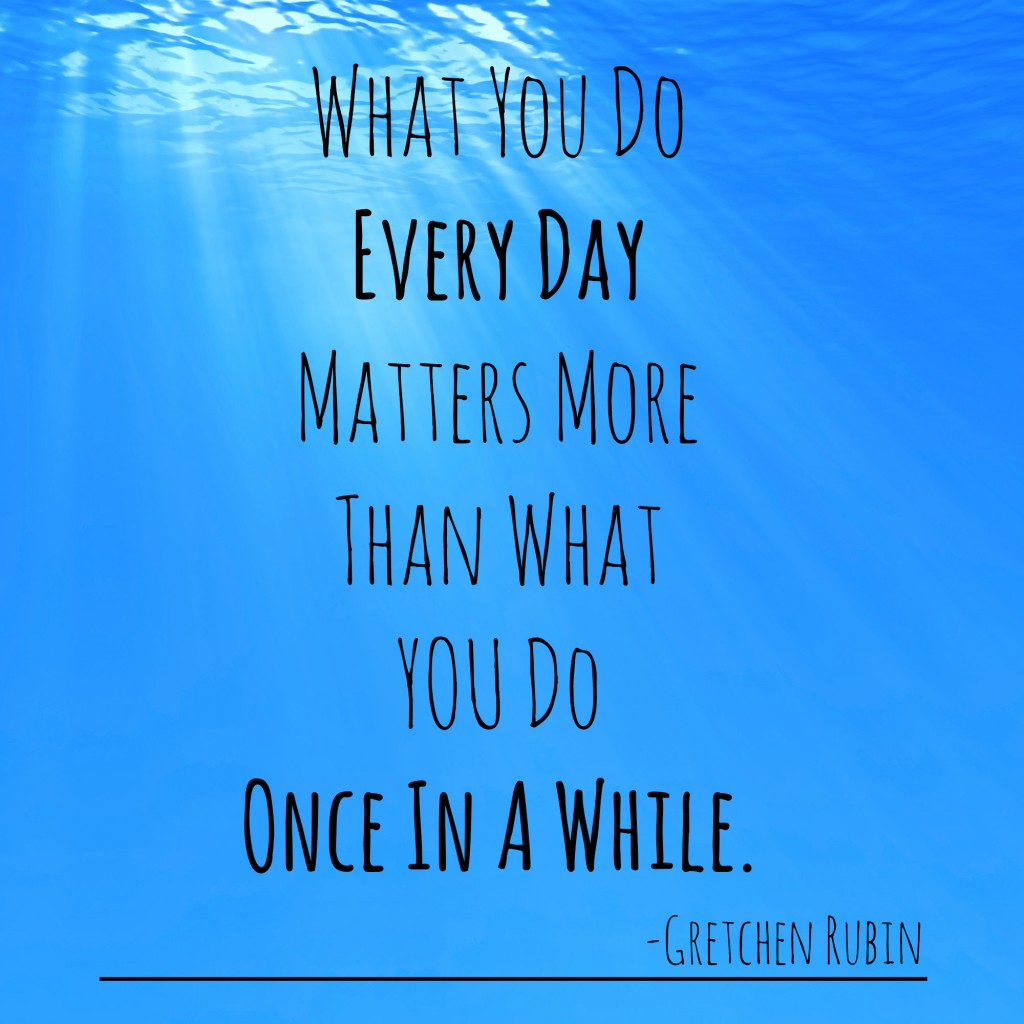
    “What you do every day matters more than what you do once in a while.” — Gretchen Rubin

    I found myself nodding in agreement this morning as I read this quote. The everyday habits (or at least the ones we do on a frequent basis) are what define us, not the occasional experiences.

    Think about this quote, and use it to assess your own life. Allow it to inspire you!

    What are YOU doing every day?

    Do your daily habits reflect the kind of life that you want to be living?

    Do your daily habits reflect who you think you are as a person?

    What changes can you implement in your life to become the person you have been envisioning all along?

    Today, I encourage you to find a few minutes to take stock of your life. Make a list of your frequent/daily activities. Are you prioritizing the important things? The hobbies that bring you joy? The people who matter most? The tasks that help you live the healthiest life you can live?

    EveryDay

  • Introduction to Dropbacks

    Introduction to Dropbacks

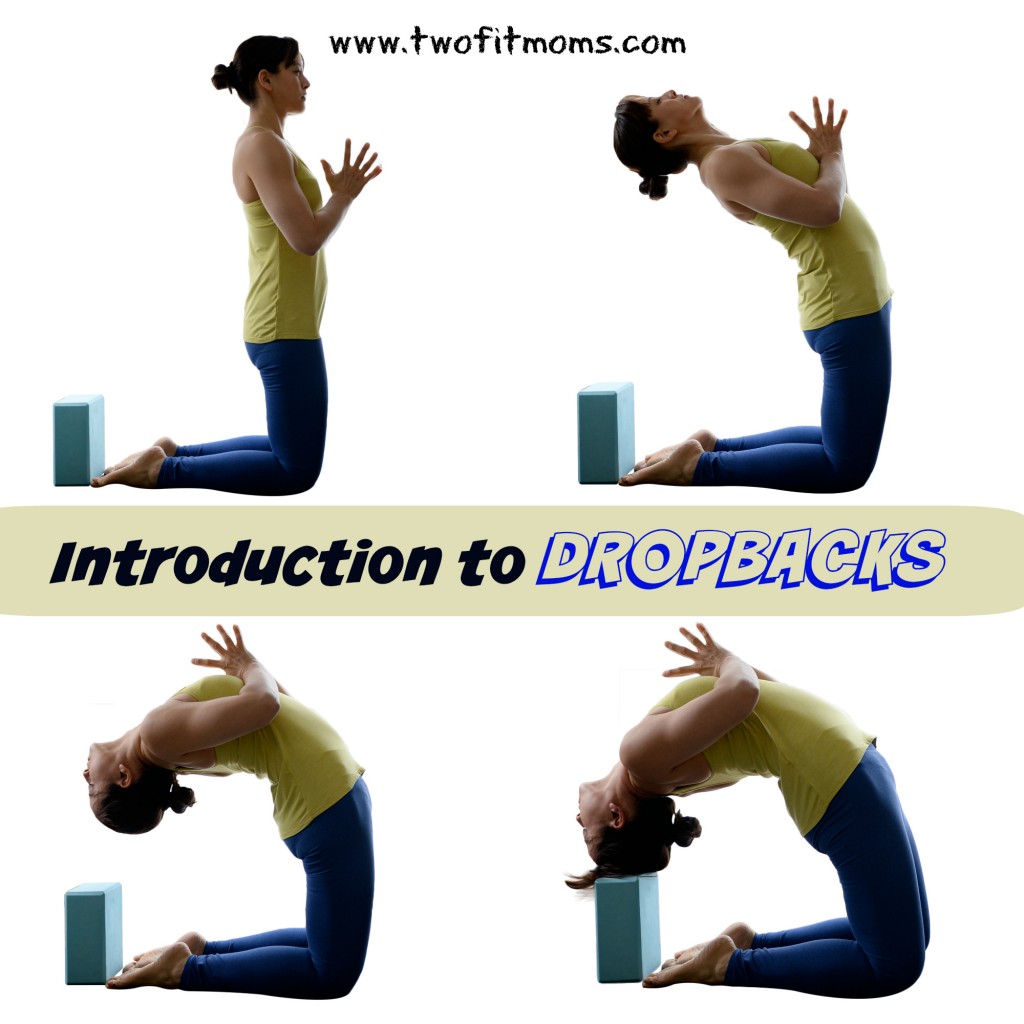
    I originally created this four-step photo tutorial for my Instagram account, but I decided today that it was worthwhile to also post it to the website. I am always looking for new and creative ways to use my yoga blocks. Here is an unconventional, but very useful way to deepen your practice with a bit of help from a block.IntrotoDropbacks

    Dropping back into any kind of backbend can be terrifying the first time. Trust me, I get it. I’ve had visions of splitting my head open, and of course, breaking my neck. Hopefully, this post will alleviate some of your fears. Rather than starting with a traditional yoga dropback, which begins in a standing position and ends in wheel pose, I recommend starting a bit closer to the ground with a camel dropback.

    If you freak out half way through the tutorial, you can simply reach your hands to the mat on either side of you. Not a big deal. This tutorial will help you build confidence at YOUR pace.

    In my own experience, I’ve found it to be much more of an accessible feat to drop back if the process is broken down into baby steps. Rather than starting with the goal of dropping your head onto the mat, let’s work with a block and drop back onto that.

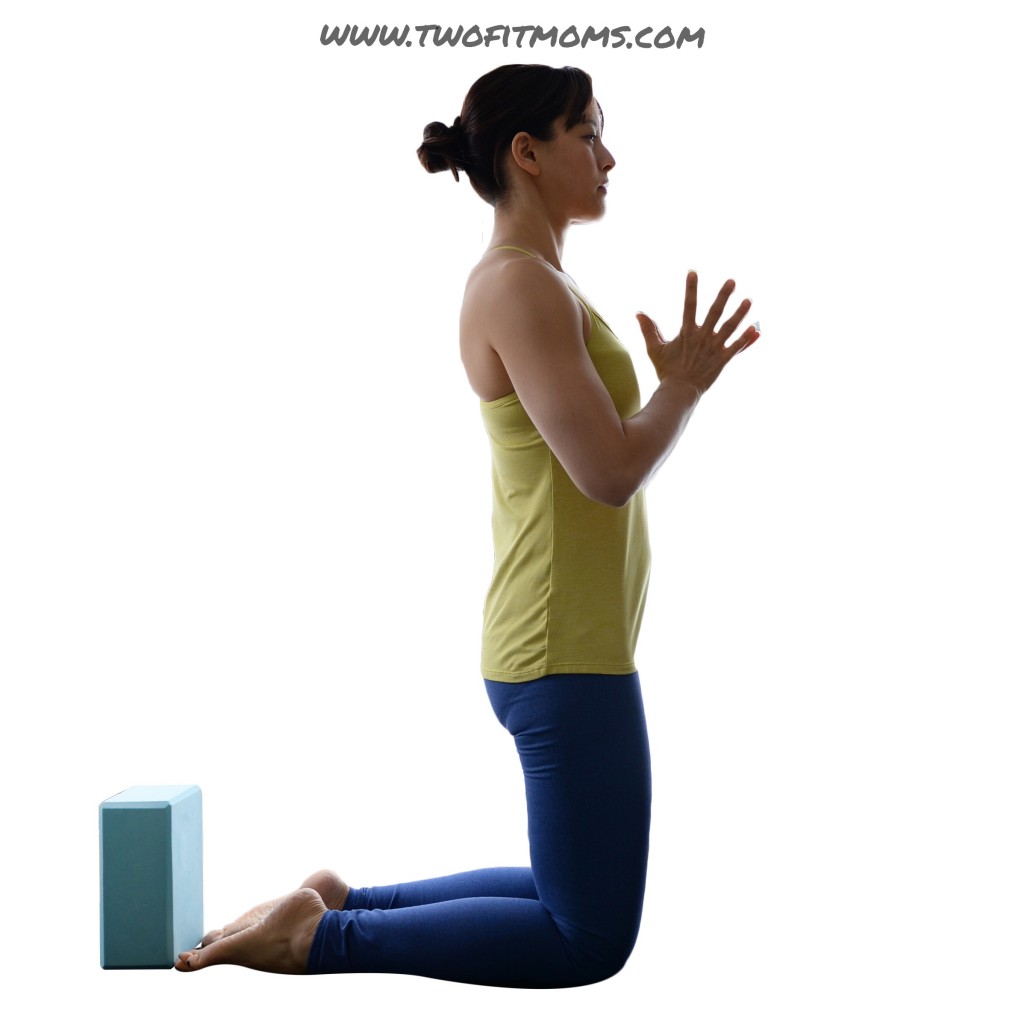
    Step 1
    Flip a block to its tallest orientation, and place it against your toes as you kneel on your mat. Bring your palms together in front of your heart.Step1wm

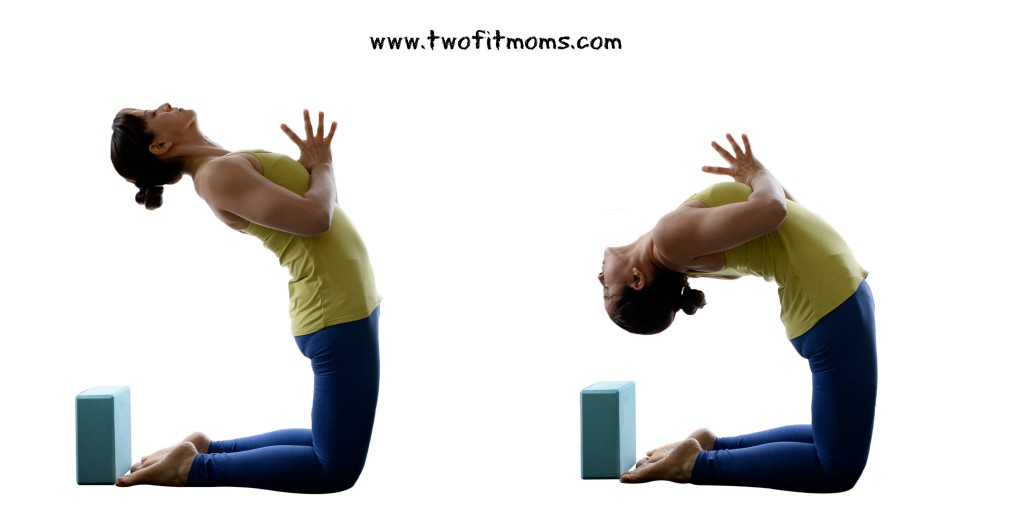
    Steps 2 and 3
    Slowly begin to push your hips forward, and find strength in your legs, as you lift your chest toward the sky and bend back. Be mindful of your breath—it’s so easy to forget to breathe while backbending. Inhale and exhale deeply through your nose.
    Steps2and3

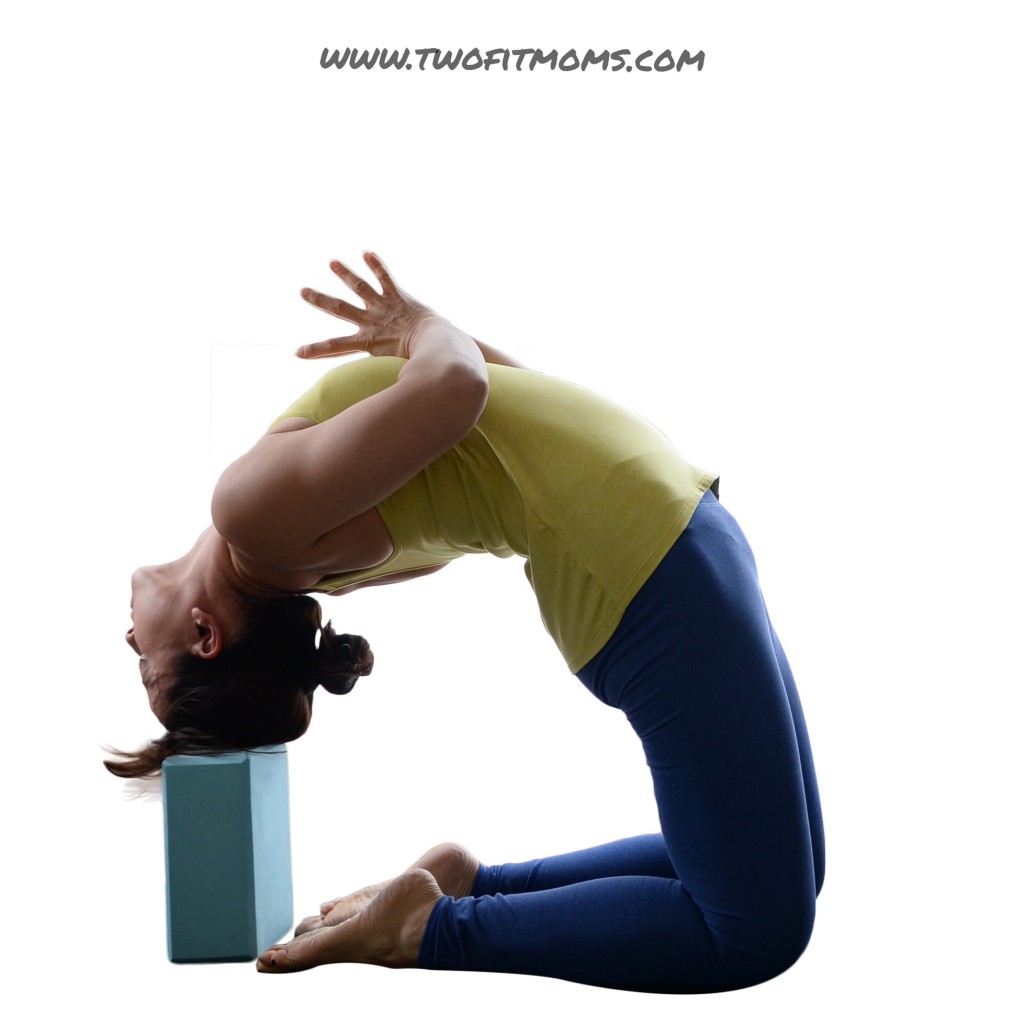
    Step 4
    Gently place the top of your head onto your block. If the block is currently beyond your reach, start with a higher surface—maybe a stool with a cushion. See if you can hold this position for a few deep breaths. To exit the pose, engage the core, engage the thighs, and slowly rise back to a kneeling position.Step4wm

    You CAN overcome your fear of dropbacks, one step at a time. Once you become comfortable with the block at its highest orientation, go ahead and flip the block onto one of its other edges to practice a deeper dropback. Let us know how you do.


  • Produce & Pesticides

    Produce & Pesticides

    It’s what we’ve all been waiting for— the results of the Environmental Working Group (EWG) annual produce study. Each year, EWG analyzes thousands of fruit and vegetable samples for pesticide residues. The most recent EWG report ranks 48 different fruits and vegetables by the total number of pesticides found on them. We have listed the 15 most contaminated fruits and vegetables here, as well as the 15 varieties of conventional fruits and vegetables that are least likely to contain pesticides.Produce and Pesticides

    Why is this so important to consider, you may ask? Well, pesticides are chemicals that exist for the purpose of killing “pests”, such as insects, mold, bacteria and weeds that interfere with the growing process. It is a known fact that some pesticides, such as organophosphates and carbamates, affect the nervous system. Other pesticides can cause skin irritation, lead to cancer, or affect the endocrine system.

    While you should take some comfort in knowing that the Environmental Protection Agency determines how much of a pesticide can remain on food that you buy, we believe that it still pays to be an informed consumer and to make your own decisions about the food you choose to ingest.

    Ideally, all of our fruits and vegetables would be grown locally and organically. Practically speaking, we do not all live in areas with supermarkets that carry vast varieties of organic produce, nor do we all have financial budgets that allow a fully organic diet. We believe that the EWG list is a helpful shopping tool if you’d like to limit pesticide exposure.

    Please note that the words “clean” and “dirty” are specifically referring to pesticides, not the quality of the produce, whether it is genetically modified, or whether it is grown locally or thousands of miles away.  Pesticides ONLY.  It is up to YOU to determine which factors are most important to consider before purchasing food.

    Here are some general guidelines:

    -If a fruit or vegetable is on the “dirty” list, make an effort to buy the organic version.

    -If you consume a particular fruit or vegetable on a frequent basis, buy organic—especially if it’s on the “dirty” list.

    -The EWG study found that although leafy greens, such as kale and collard greens did not make the “dirty” list, they tend to be treated with particularly toxic pesticides. If you frequently purchase conventional greens, cook them. Pesticide levels typically diminish when food is cooked.

    -Use organic greens for juicing.

    -Go ahead and make that guacamole with conventional avocados. Only 1% of avocados tested showed any detectable levels of pesticides!

    -Remember to thoroughly wash your produce before eating. I know it’s tempting to just wipe that apple on the edge of your shirt. Without washing your produce, your risk of ingesting pesticides is greater.


  • Beginners’ Tips to Start a Meditation Practice

    Beginners’ Tips to Start a Meditation Practice

    According to yogic philosophy, it takes 40 days to break a destructive habit or to develop a new, healthy habit.  Today marks day 27 of my 40-day meditation journey.  I’m more than half way through to my 40-day goal, and at the end of it all, there is no end.  The end of 40 days will just mark a new beginning.Meditation

    Ultimately, my hope is to have a meditation practice that is engrained into my daily life.  I want it to feel as natural as brushing my teeth or making my morning tea.  Why am I so set on developing a lifelong meditation practice?  Well, meditation, I’ve heard, has incredible powers—the power to reduce stress, promote deeper sleep—even cure physical ailments and lessen physical pain.  If any of this is true, I need a piece of it.  You probably do, too.

    This is not a post to teach you how to meditate.  Rather, this is just my list of observations based on my own experience.  My journey is just beginning, but I am eager to share what I’ve learned so far: 

    There is no “right” time to meditate.  Originally, I thought the “right” time was at the crack of dawn.  I reasoned that the early morning stillness of my household would be conducive to a peaceful, meditative atmosphere.  I also figured that my mind wouldn’t be racing with work and family obligations so early in the day.  In theory, this all made sense, and I thought I had it figured out.  I didn’t.

    I quickly realized that my body just hurt too much in the morning to meditate.  As a newbie, it’s hard enough to enter a meditative state when all conditions are perfect.  Just imagine how difficult it is if you’re focusing on your arthritic knee the entire time!  Ultimately, I moved my meditation practice to the evening when my joints were generally happier and my body felt pretty good.  I highly recommend that you try meditating early in the morning when your mind tends to be clear, and adjust the time of day if necessary.

    Moving your body first makes a BIG difference.  It is MUCH easier to sit in stillness if your muscles are warm and loose.  If you can’t fit an entire workout prior to your meditation, you will still feel much more comfortable if you stretch for even just a few minutes.  A few rounds of sun salutations and some gentle hip openers should do the trick.

    Your meditation space may not be the most obvious choice in your house.  The most peaceful place in my home happens to be in my living room next to a large set of windows overlooking my backyard.  I assumed this was the ideal spot to feel enlightened and grounded.  It wasn’t.  Winters in New Jersey are cold, and even with a good heating system, I was freezing my ass off by the windows.  I moved from room to room in my house, and surprisingly, I ended up on the floor of my bedroom closet.  It was the perfect meditation spot.  Go figure.  Start your meditation practice in the most peaceful spot in your house.  Maybe it will work out just fine, but don’t be too surprised if you test out a number of different rooms and then end up in an unlikely location.

    A pillow and a blanket work wonders.  No, it’s not bedtime, but you will probably find use for your pillow and blanket.  I’m not sure if this is typical, but as soon as I close my eyes to meditate, I become hypersensitive and aware of every ache and pain in my body.  My back aches.  My hip suddenly hurts.  My feet feel cold, and I can’t concentrate.  I’ve learned from experience to keep a pillow close by to sit on or to use as a bolster.  Sometimes, I use the blanket across my lap or around my shoulders.  I’m not always cold, and I don’t always use the blanket, but I can pretty much guarantee that I would be freezing if I didn’t choose to have a blanket close by.  That’s just the way life works.

    You will think you suck at meditating, and that’s okay.  At the end of each day, my teacher would send me a text and ask about my meditation.  For the first couple of weeks, my answer was the same.  “Yes, I meditated, but I really sucked at it.  I’m not sure if it’s even fair to call it meditation.”  That’s when my teacher enlightened me.  She said everybody thinks that they suck at meditation.  No one walks around claiming to be excellent at meditation.  It’s an evolving practice.  Some days, you will easily enter the zone, and other days, you will be making grocery lists in your head and thinking about the dry cleaning that you need to drop off.  Don’t beat yourself up.  Everyone who is new to meditation is going through the same thing.

    There is no one-size-fits-all approach to meditation.  I experimented a ton.  One day, I meditated while holding my hands in a strengthening mudra.  The next day, I meditated while practicing a forceful breathing technique.  Then I tried using music in the background.  Then I tried breathing normally while focusing on my third eye.  And then there was this one time that I tried to meditate with my eyes open…while counting backwards in my head.  Each time I tried a new technique, I learned what worked and what didn’t.  Don’t be afraid of trying something new.  Keep experimenting until you find a routine that works for you.

    Your attitude towards meditation matters.  The first few times that I meditated, I felt very antsy.  I had a lot to accomplish, and sitting around doing nothing was a difficult concept for me to swallow.  I’m glad it didn’t take me long to come to this realization—meditation is not “sitting around and doing nothing.”  Well…let me rephrase that.  Meditation IS sitting around and doing nothing, but the effects of meditation are FAR from “nothing”.  Meditation is a form of therapy.  It’s free, it’s available to everyone, and you can perform it on yourself.  Reconsider your attitude if you are concerned about wasting your time “doing nothing”.  I assure you that your mental and physical well being is not a waste.

    The way to get better at meditating is to meditate.  And here is the most important thing I’ve learned so far on my journey:  You can read books about meditation, analyze all sorts of different techniques, and ask for advice from your friends/yoga teacher, but at the end of the day, the way to get better at meditating is to just meditate.  It’s as simple as that.