Author: Masumi Goldman

  • Working for the Dream:  Hanumanasana

    Working for the Dream: Hanumanasana

    Even though you know that yoga is never about reaching a final destination, it’s natural to have goals for your practice.  The trick is to be able to set yoga goals without becoming attached to an expectation for any particular outcome.  Go ahead and practice those inversions, but don’t get caught up in negative self-talk if you don’t achieve those goals according to some pre-set schedule.  Go ahead and practice each day with the goal of increasing your flexibility, but don’t get frustrated by the length of time that it’s all taking to see any progress.  Set your intentions, but never forget to enjoy the journey!

    Monkey Pose (Hanumanasa), where the legs are split from forward to back, is a challenging posture that falls into the category of “Dream Poses” for many yoga practitioners. Not only does this pose require flexibility in the hamstrings (front leg), but it also requires flexibility in the hip flexors (back leg). Whether or not you ever find yourself in the full expression of Hanumanasana, you can still enjoy the journey with these very effective, preparatory poses. Before beginning this sequence, be sure to warm up your body with multiple rounds of sun salutations.

    Head-to-Knee Seated Forward Bend
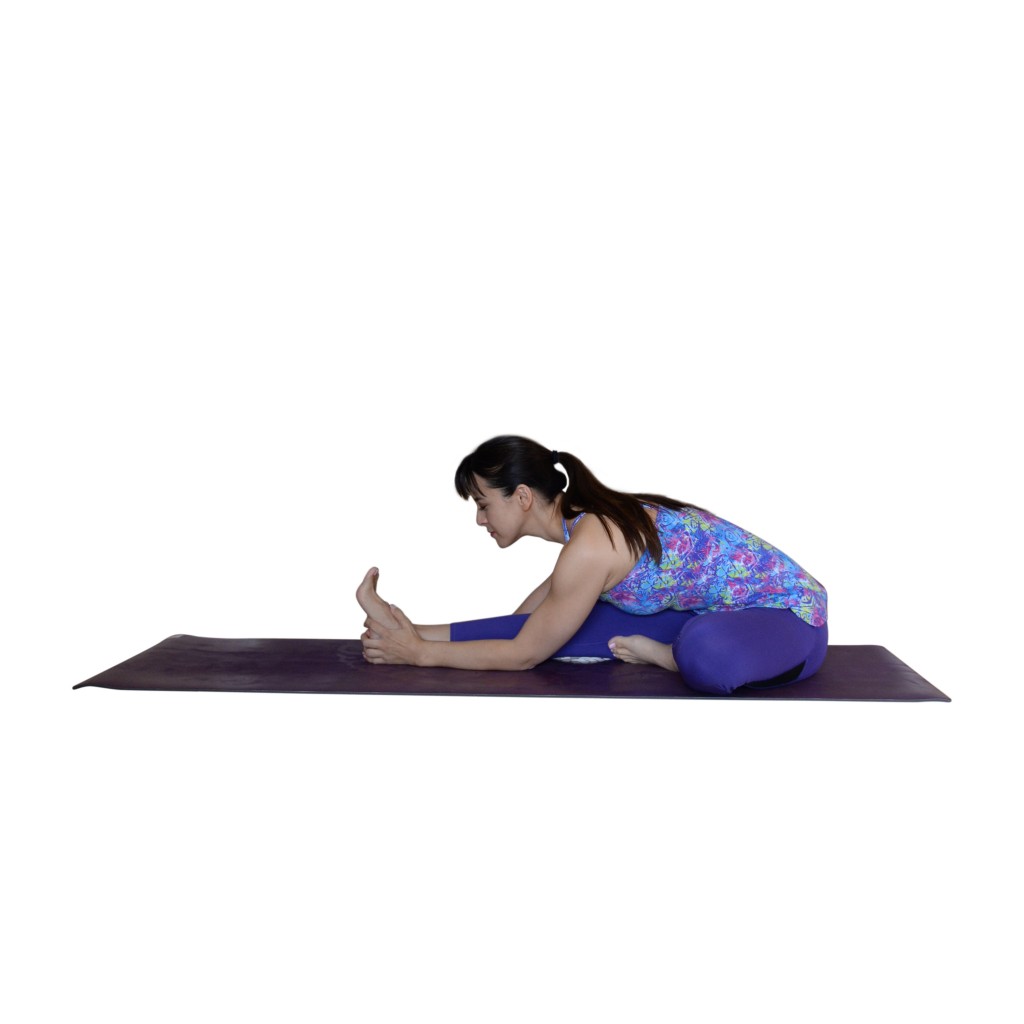
    JanuSirsasanaTake a seat on your mat with your legs extended straight in front of you. Bend your left knee and bring the sole of your left foot to the inside of your right thigh. Sit up tall, and flex your right foot to engage the hamstrings. Rotate your torso slightly to the right to align your belly button with the center of your right thigh. If your hamstrings are quite tight, sitting up tall might be enough of a stretch for you. Stay here and take deep breaths. For a deeper stretch, fold over your extended right leg, being mindful to find extension in the spine and avoid rounding the upper back. Hold this pose for 5-10 breaths before releasing the stretch.

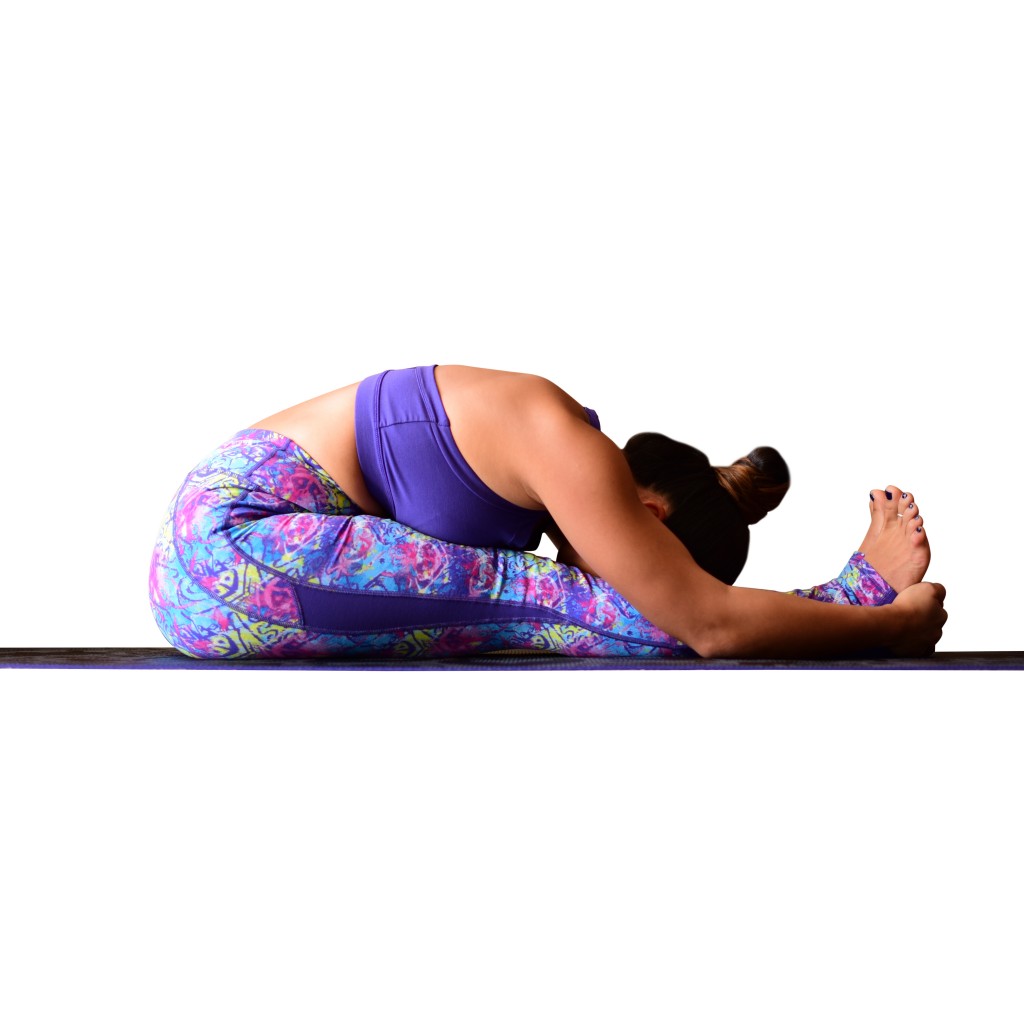
    Seated Forward Bend
    ForwardFold

    A seated forward fold is an intense stretch that simultaneously stretches the hamstrings on both legs. Sit on your mat with your legs extended straight in front of you. Flex both feet to energize the legs and to engage the hamstrings. Sweep your arms up over your head, find length in the spine, and hinge forward from the hips as you reach for your feet. Rather than focusing on bringing the forehead to the shins, focus on pulling your chest forward to lengthen the spine. Beginners can use a strap around the soles of the feet and hold the strap with both hands. Hold this pose for 5-10 breaths.

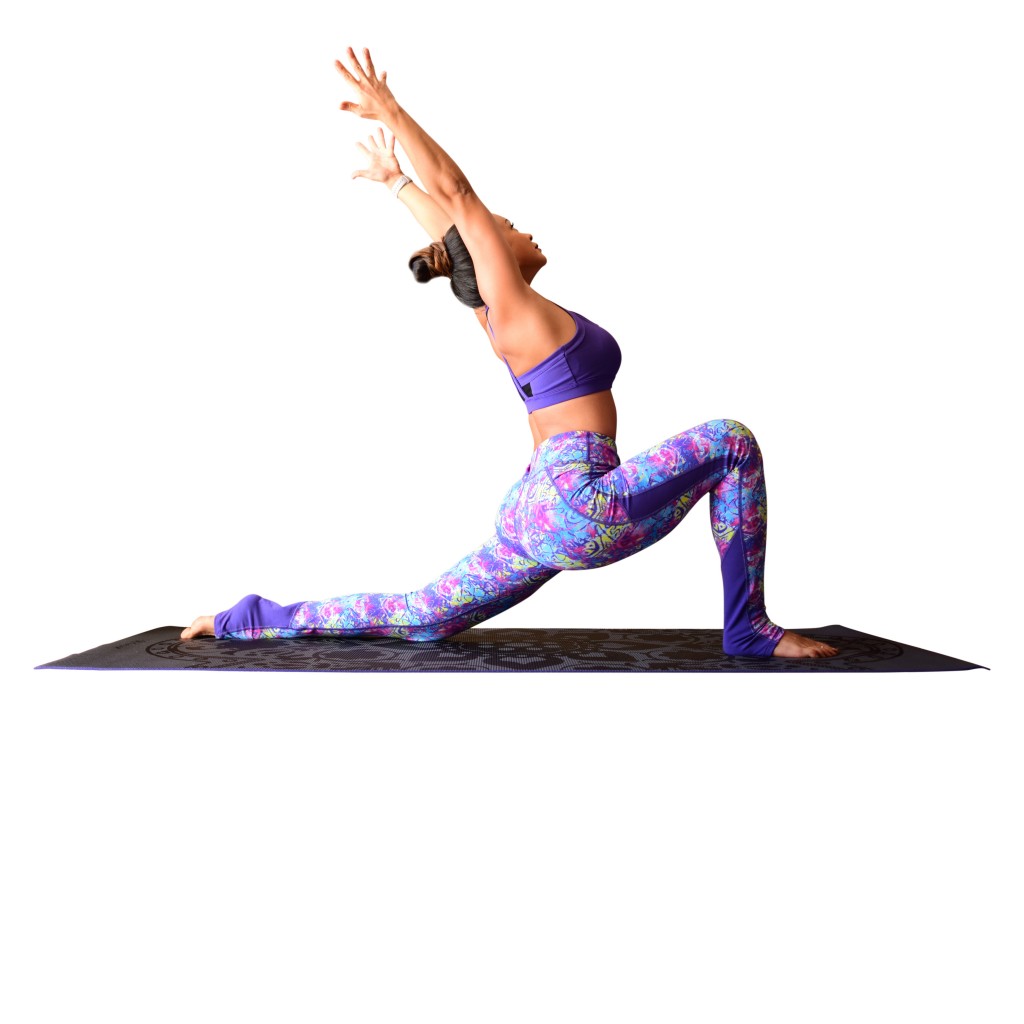
    Low Lunge
    LowLunge copy

    Low lunge is a great front-body stretch that targets the hip flexors. Begin in Downward Facing Dog and step your right foot in between your hands. Lower your back knee to the ground, and untuck the toes. Bring both hands to the top of your right thigh, and begin to bend deeply into the front leg. Be sure to keep the torso upright to get the most effective stretch in the hip flexors. Feel free to keep your hands on your front thigh for support, or extend your arms and lift your chest toward the sky for a backbend. Take 5 deep breaths before releasing the stretch.

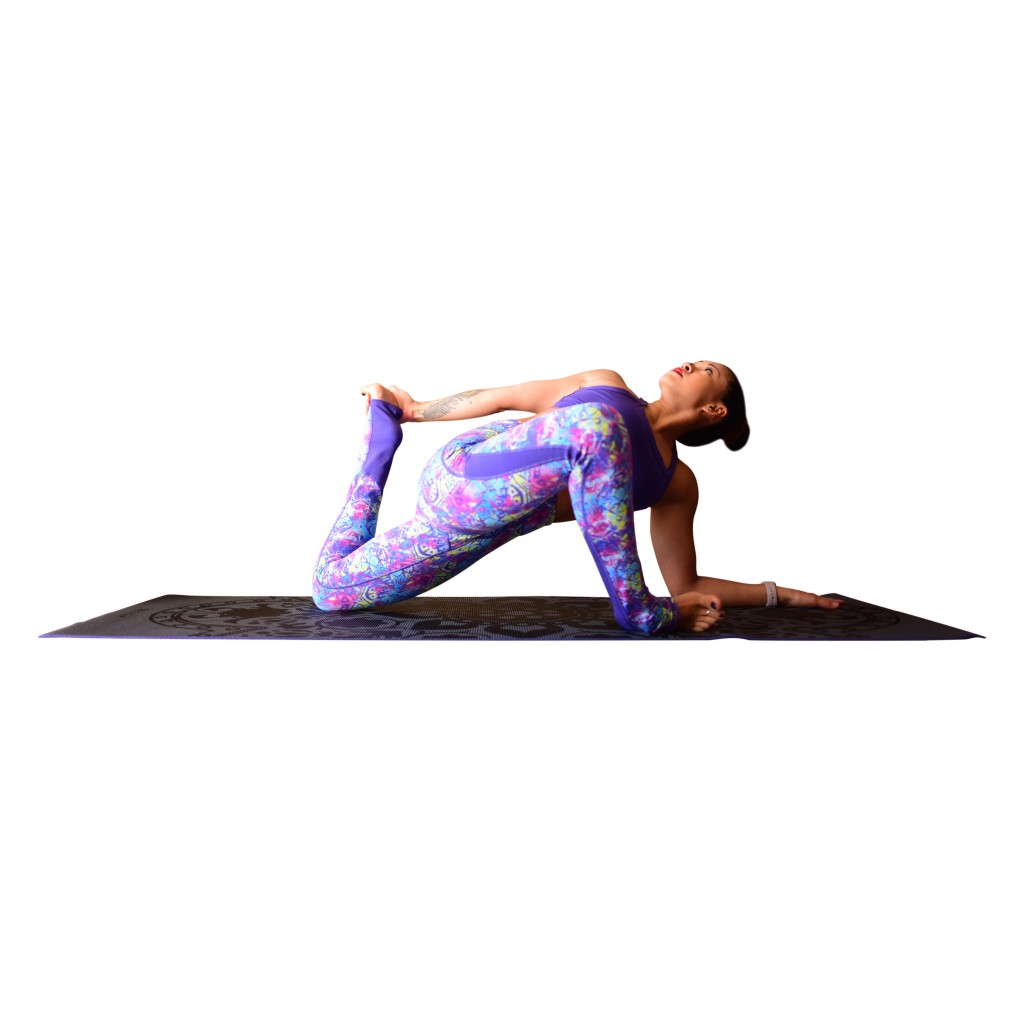
    Twisted Monkey
    TwistedMonkey copy

    From Downward Facing Dog, step the right foot to the outside of the right hand, lower the back knee to the ground, and lift the back foot up so that the toes point up toward the sky. Sweep your right arm back, and grab the outside edge of the lifted foot. Begin to pull the foot in toward the body to stretch the quadriceps. If you are unable to reach your foot with your hand, feel free to use a strap around your foot to make the stretch accessible. Next, begin to roll onto the outside edge of the front foot and allow the right knee to fall to the side for a hip stretch. Hold this pose for 5 full breaths before slowly releasing your back foot and rolling back down onto the sole of your front foot.

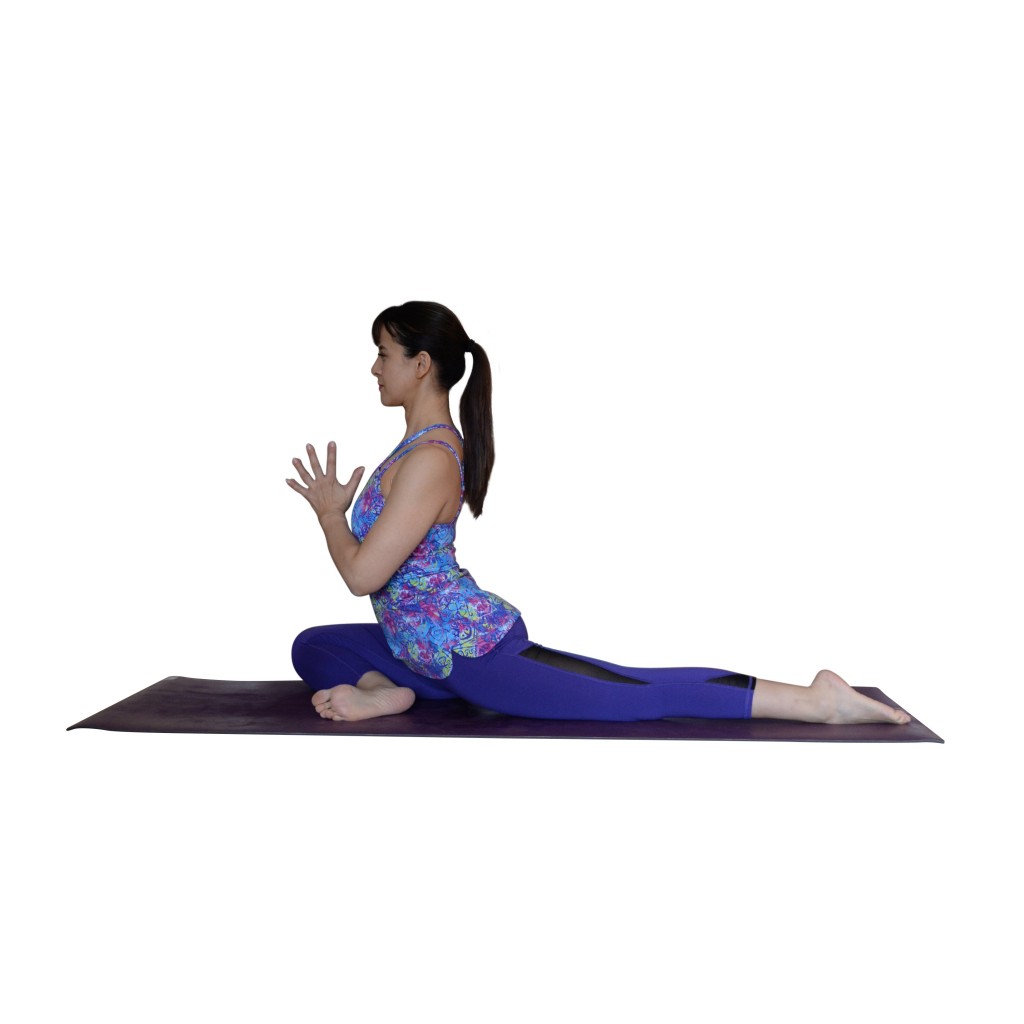
    Pigeon (upright)
    Pigeon

    Pigeon pose is an effective hip opener that not only stretches the outer hip of the front leg, but it also stretches the hip flexors with the extension of the back leg. To come into the pose, begin on hands and knees in Tabletop position. Bring your right knee onto the mat behind your right wrist. Tuck the toes on your left foot, and begin to extend the left leg straight back. Sink the pelvis toward the floor. If you find that you are rolling to the right, place a block under right hip. Rather than folding forward over your bent leg, walk your fingertips back and practice sitting upright to effectively stretch the hip flexors. Hold this pose for 10 breaths before moving on to the next pose.

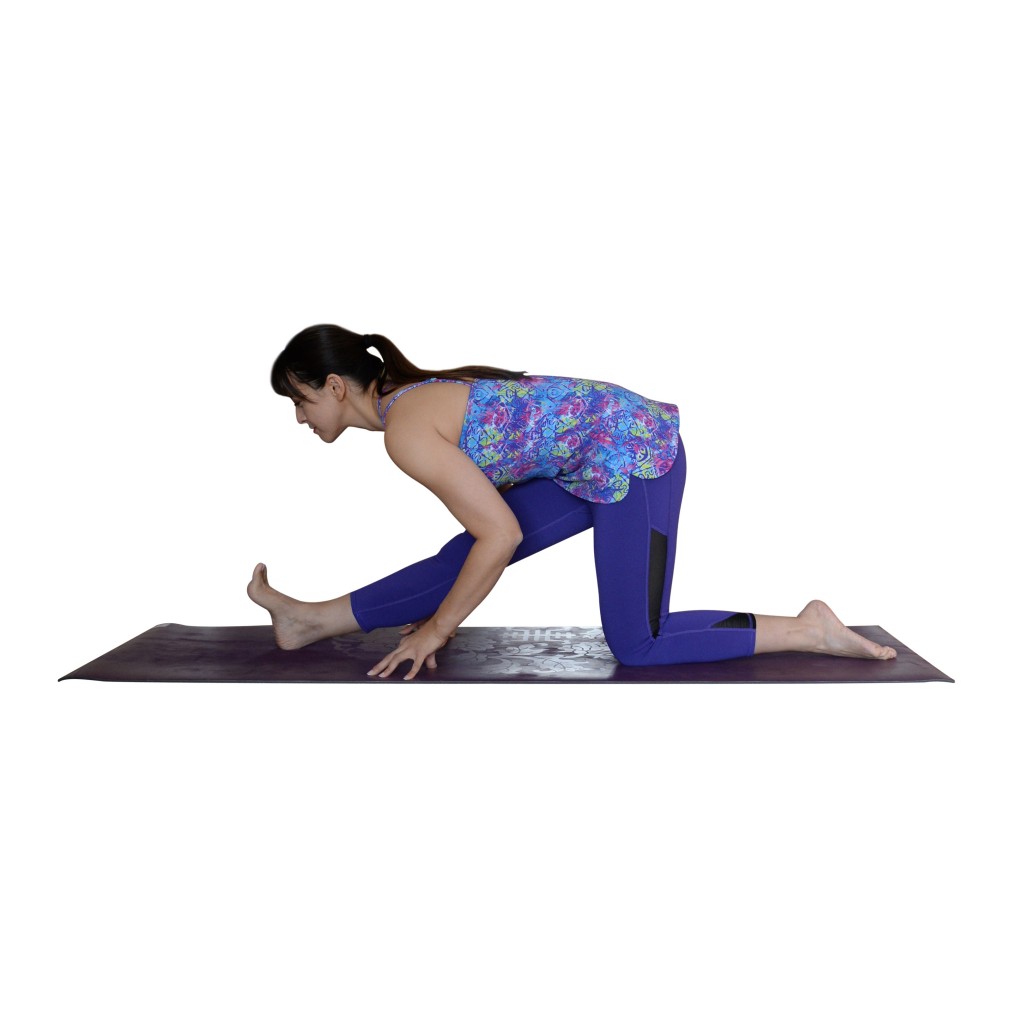
    Half Split
    HalfSplit

    From Downward Facing Dog, step your right foot in between your hands. Lower your back knee to the ground, and rise onto your fingertips. Draw both hips back in space while straightening the right leg, until the left hip is aligned directly over the left knee. Flex the right foot to energize throughout the length of the extended leg. Begin to walk the fingertips forward. Fold over the straightened leg, while maintaining length in the spine. Focus on pulling the chest forward, rather than bringing your forehead to your shin. Hold this pose for 5-10 deep breaths before moving on.

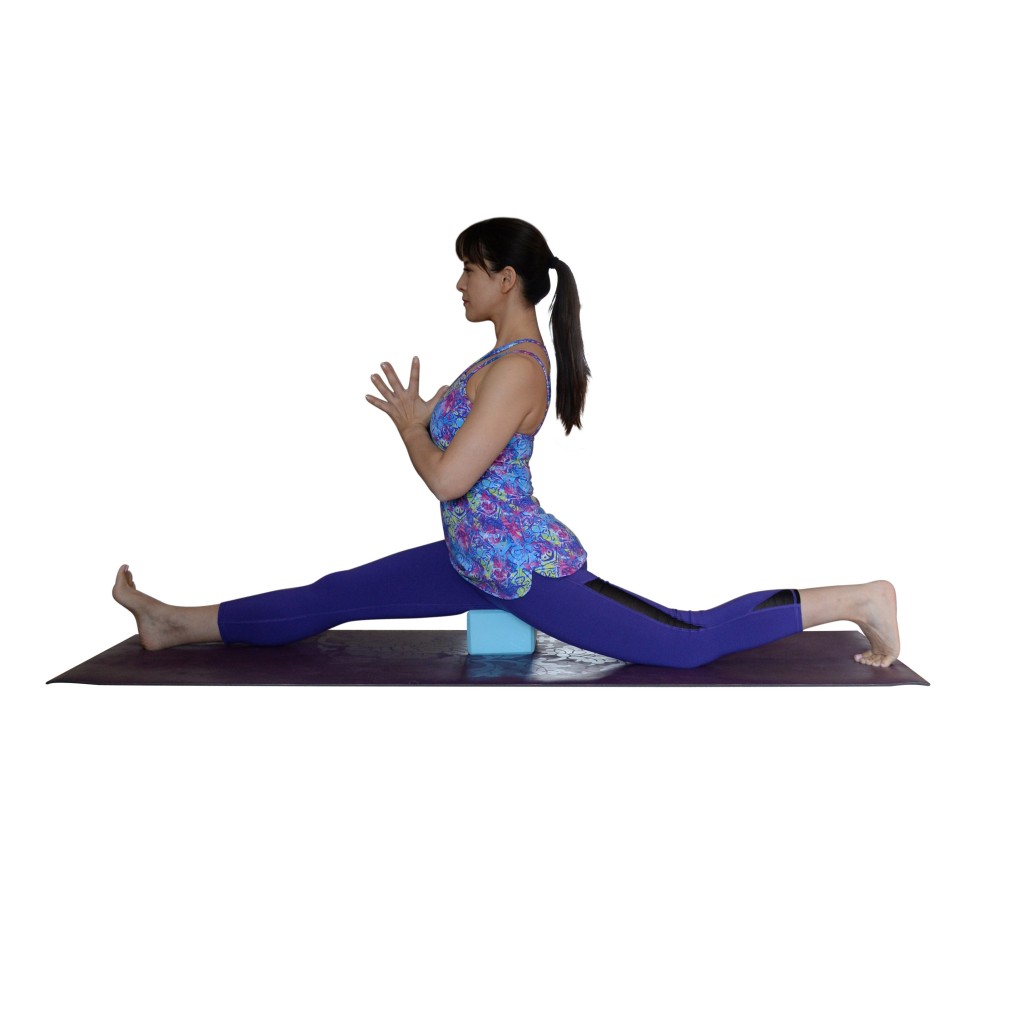
    Split with blocks
    SplitBlocks

    Begin in a half split, and slowly extend your back leg by pressing into the floor with your hands while scooting back on your knee a few inches at a time. Use a block (or two) under the hip of the front leg to support the body.  The extra height from the block effectively lifts the floor by several inches and allows you to practice the full expression of the pose at any stage of flexibility.  Sit up tall to get the most effective stretch in the hip flexors, and keep the toes of your back foot tucked to help keep both hips equidistant to the top of the mat. Breathe deeply, and hold this posture for 5-10 breaths. If your body feels ready, and you happen to be using two blocks under your front hip, try removing one of the blocks and holding the posture for another 5-10 breaths.


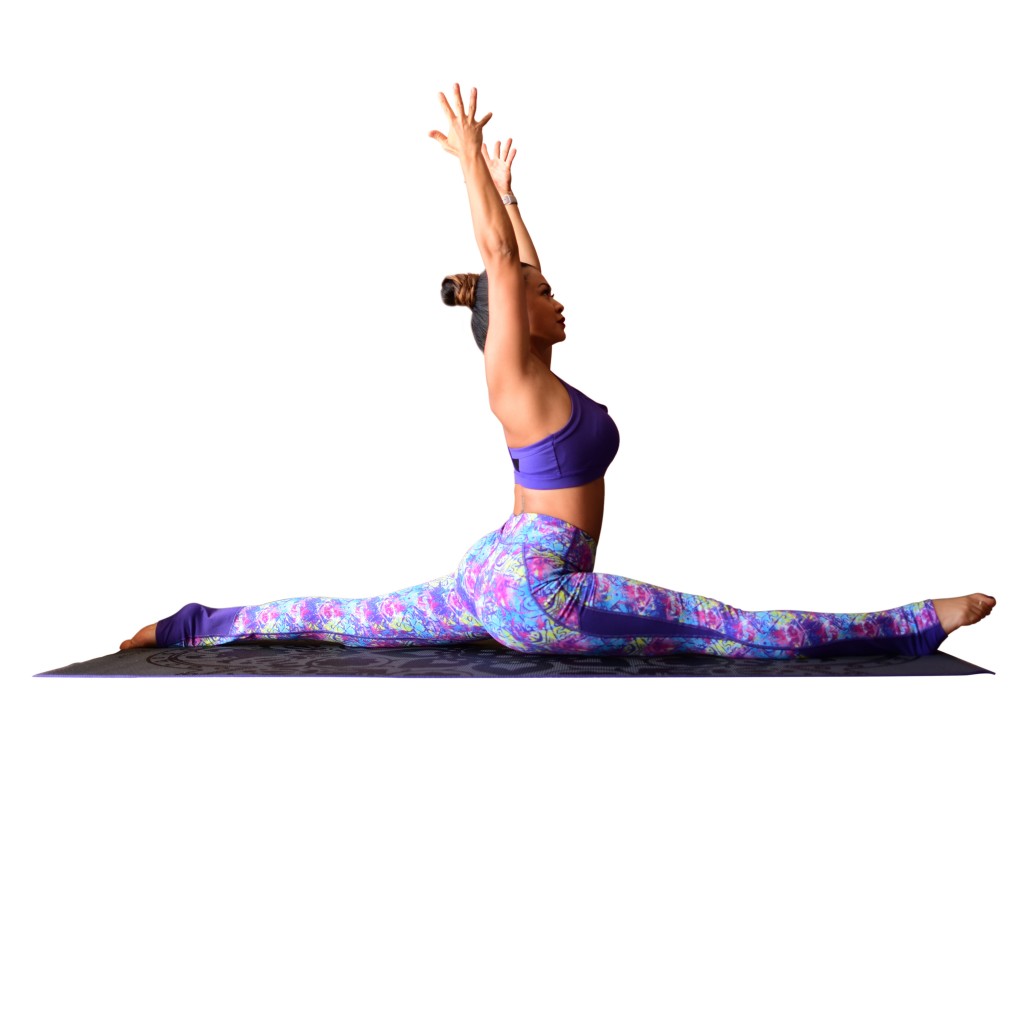
    Split (full expression of the pose)
    Split

    If and when your body is ready, you will find that the full expression of Monkey Pose is a natural extension of practicing with the support of blocks. Remove the block from under the right hip. Keep your legs active by hugging the inner thighs in toward each other and flexing your right foot so that the toes point upward. You have the option of keeping the toes of your back foot tucked to help keep your hips aligned properly. Leave your fingertips on the floor for support or for a deeper variation, bring your palms together in front of your heart or extend your arms toward the sky. Hold this pose for 5 full breaths before releasing the stretch and repeating the entire sequence on the opposite side of your body.
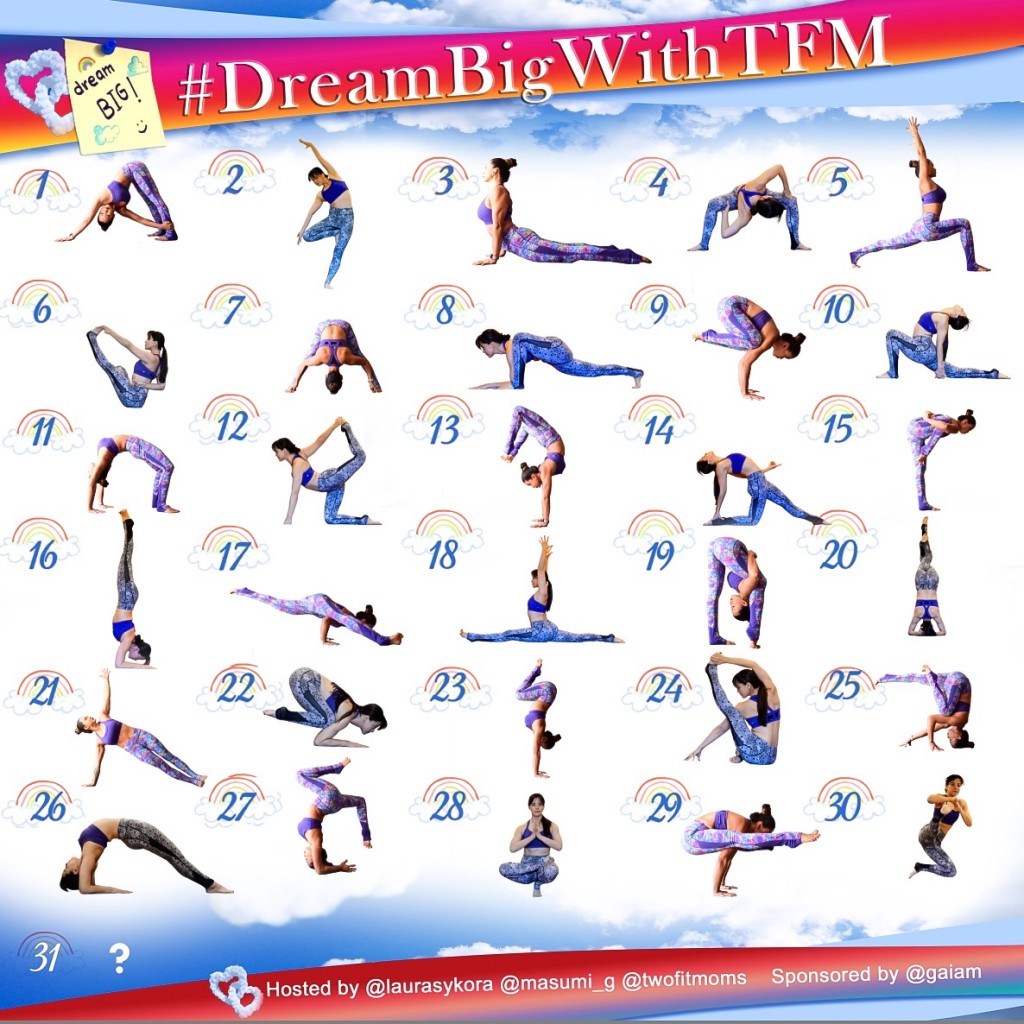
  • Dream Big in March!

    Dream Big in March!

    Hello to our online community!

    Tonight, we kick off our March yoga challenge on Instagram by posting instructions for the first pose.  The theme this month is “Dream Big”.  We are gearing up for the launch of our new clothing line with Gaiam in April, and honestly, it wouldn’t be happening if we didn’t start with a dream.  DreamBigWithTFM

    We want you to DREAM BIG, too, and develop a yoga practice that you love.  The goal of the challenge is to commit to your practice and to participate in some way, every day.  Can’t do all of the poses shown?  No problem.  Show us what you CAN do.  Modify. Get creative.  Have fun, and realize that you can be your own source of inspiration!

    For complete details about this challenge, follow @twofitmoms on Instagram, and find the full list of instructions for the challenge.

  • 4 Ways to Challenge & Enhance Your Practice with Yoga Blocks

    4 Ways to Challenge & Enhance Your Practice with Yoga Blocks

    If you think yoga blocks are just for beginners that can’t touch their toes or for injured yoga practitioners that can’t sit between their heels in hero pose, think again. There are plenty of ways to get creative and use your blocks to deepen your practice in a challenging, fun way. Here are four suggestions:

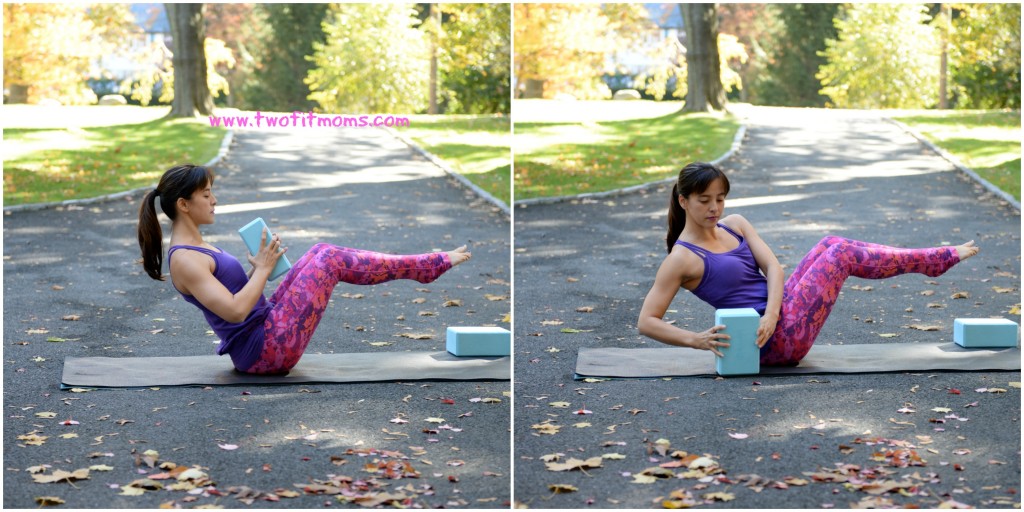
    Twist & Tap
    Fire up your core in boat pose by holding a yoga block. Slowly twist from the lower belly to the right, tap the block on the ground to the right, and untwist your torso, coming back to center. Begin to twist to the left, tap the block on the ground to the left, and come back to center. Consider that to be one repetition. Keep your core engaged, your chest lifted, and avoid collapsing into your belly and rounding the back. The shins can remain parallel to the ground throughout the exercise, or you can extend your legs straight for a more intense variation. Work up to 12-15 repetitions.TwistAndTap

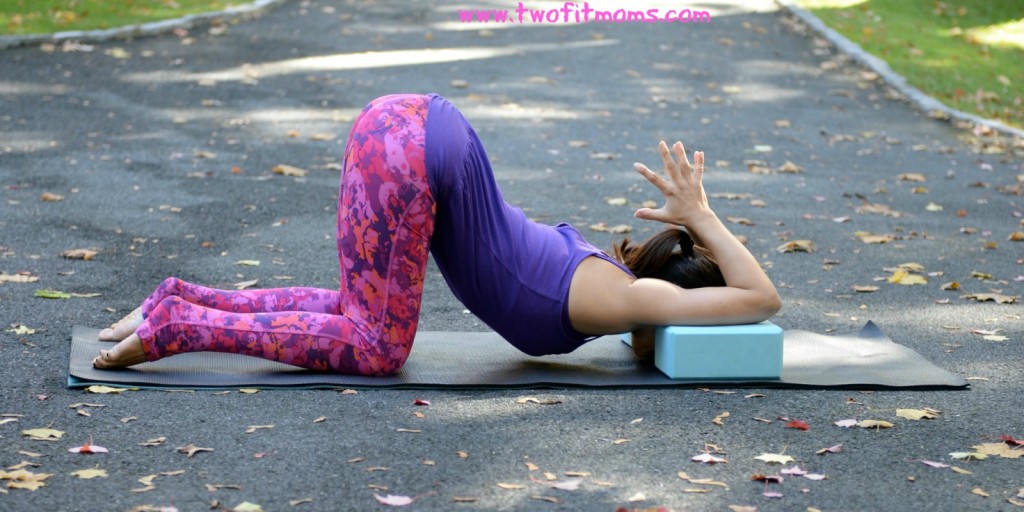
    Chest & Tricep Opener
    Place two yoga blocks on the ground, shoulder width apart. Kneel on the mat, and rest your elbows and triceps on the blocks. Keep your hips stacked over the knees, and begin to sink your chest toward the ground as you bring your hands together in prayer over your head. This pose is very much like puppy pose with the added benefit of a deep tricep stretch. Hold this pose for 5 to 10 breaths, sinking your chest lower with each breath.ChestTricepOpener

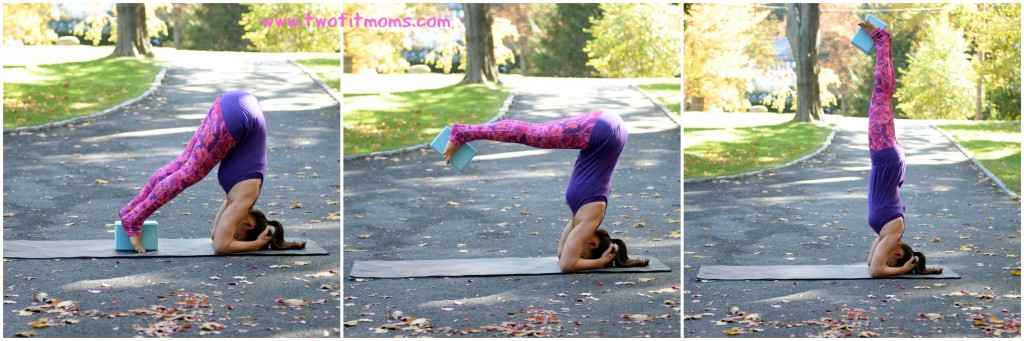
    Squeeze a Block in Inversions
    If your eyes glaze over when you hear your yoga teacher talking about internally rotating the thighs and hips while performing inversions, no need to worry. This exercise will solidify the concept in your mind, and you won’t forget anytime soon. By squeezing a yoga block between your feet as you slowly lift into an inversion, not only will you train your core muscles, but you will also automatically create a slight internal rotation in your legs that will help you stabilize and build strength. Go ahead and try this exercise with any inversion of your choice.HeadstandCollage

    Relaxing, Deep Backbend
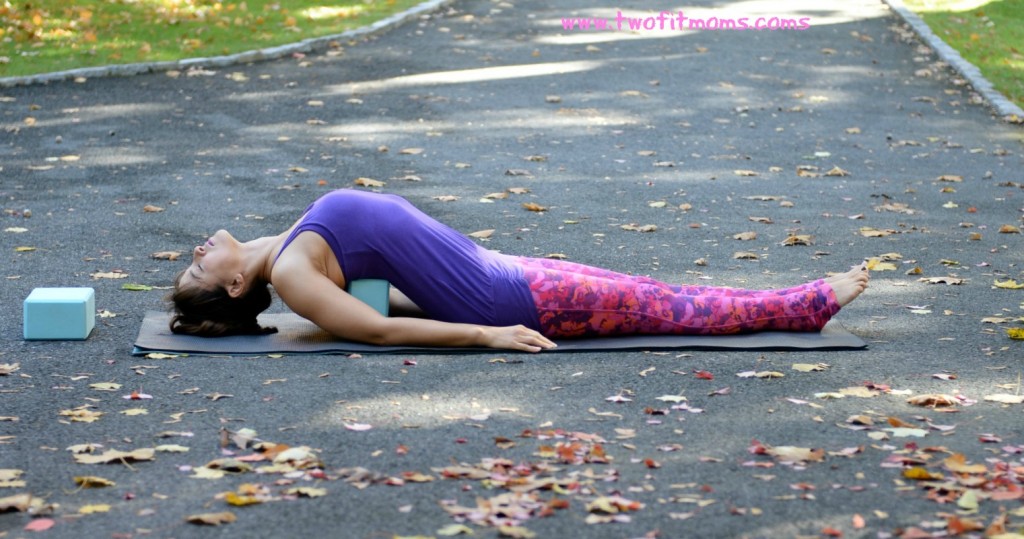
    In my own personal practice, I’ve found this to be the single most effective stretch for the upper back and chest. If you are looking to deepen your backbend practice, it’s so important to stretch in various ways to help create an even backbend through your lower, middle and upper back. Place a block underneath your shoulder blades as you lie on the ground. If you tend to be very tight across the chest and back, start out by placing the block on shortest height. Breathe for 5-10 breaths before turning the block so that it’s resting in its next tallest orientation. Again, breathe for 5-10 breaths, and allow the chest and back to open up bit by bit. Finally, if your flexibility allows, turn the block to its highest orientation, and lie across the block for another 5-10 breaths. Try placing a second block under your head like a pillow for more support.UpperBackOpener

  • Small Space Yoga

    Small Space Yoga

    When you’re confined to a small space, you don’t have to give up on your yoga practice! These eight standing poses can be your go-to postures when space is limited, and there’s no yoga mat in sight.

    Most of you know that I’ve spent a lot of time in the children’s hospital this past year. I never brought my yoga mat into the hospital, but I always managed to stand up and stretch regularly. (You can get really stiff sitting/standing/hovering at a bedside.) I’m a major germaphobe, so I never wanted my hands to touch the dirty hospital floor. Instead of touching the floor, I managed to get creative and effectively stretch each body part in a standing position with very limited space. It’s this experience of no-mat yoga that inspired these poses below. This is a set of poses that can be done while on vacation in a tiny hotel room or even in the airport. I hope you give them a try and add them to your regular practice. Enjoy!

    Dangle Pose
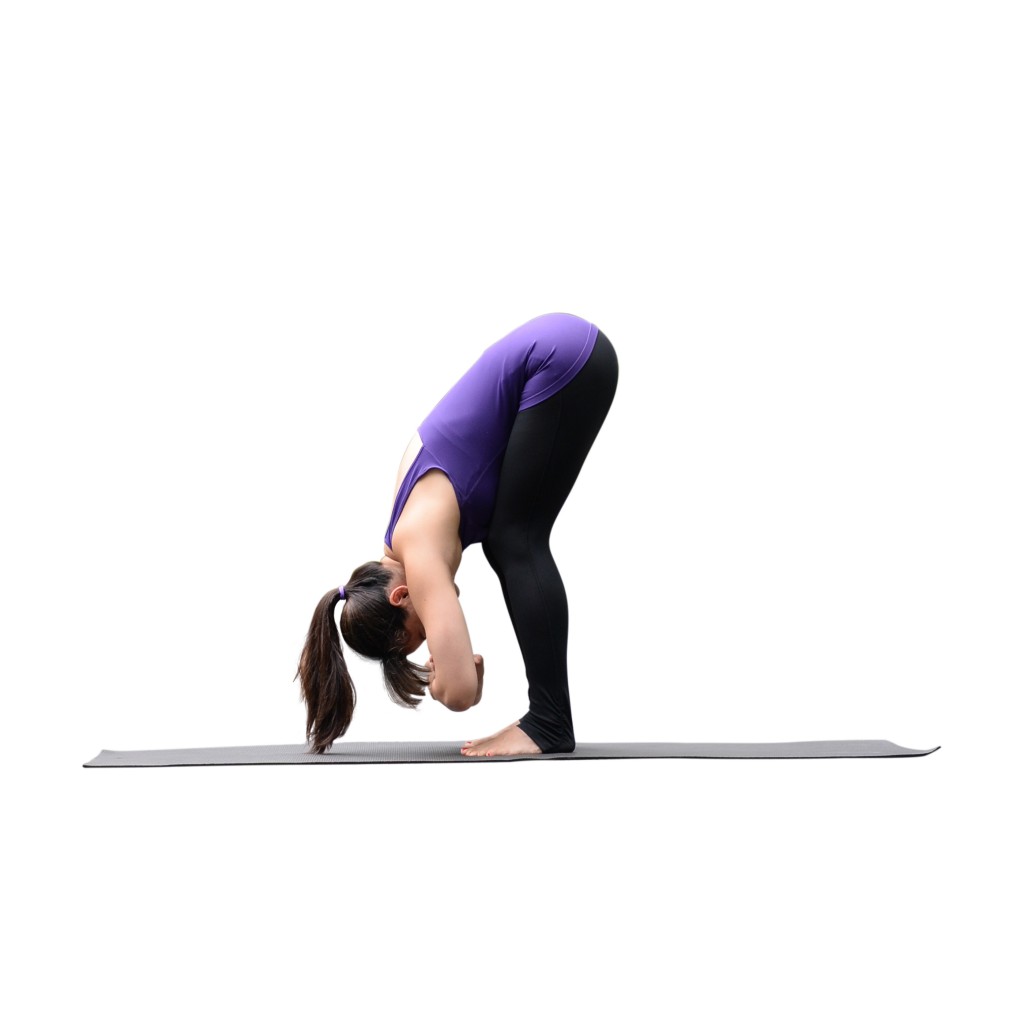
    Separate your feet hip-width’s distance apart, bend your knees, and bring your chest to your thighs. Fold forward, grab opposite elbows, and settle into this pose for two to three minutes. While this pose may resemble Uttanasana, which is an active stretch of the hamstrings, the goal in this yin pose is to dangle the upper body for a longer period of time to help release the lower back.  Remember to relax your head and neck, unclench your jaw, and release any tension that you might be holding in your face.Dangle

    Garland Pose (Malasana)
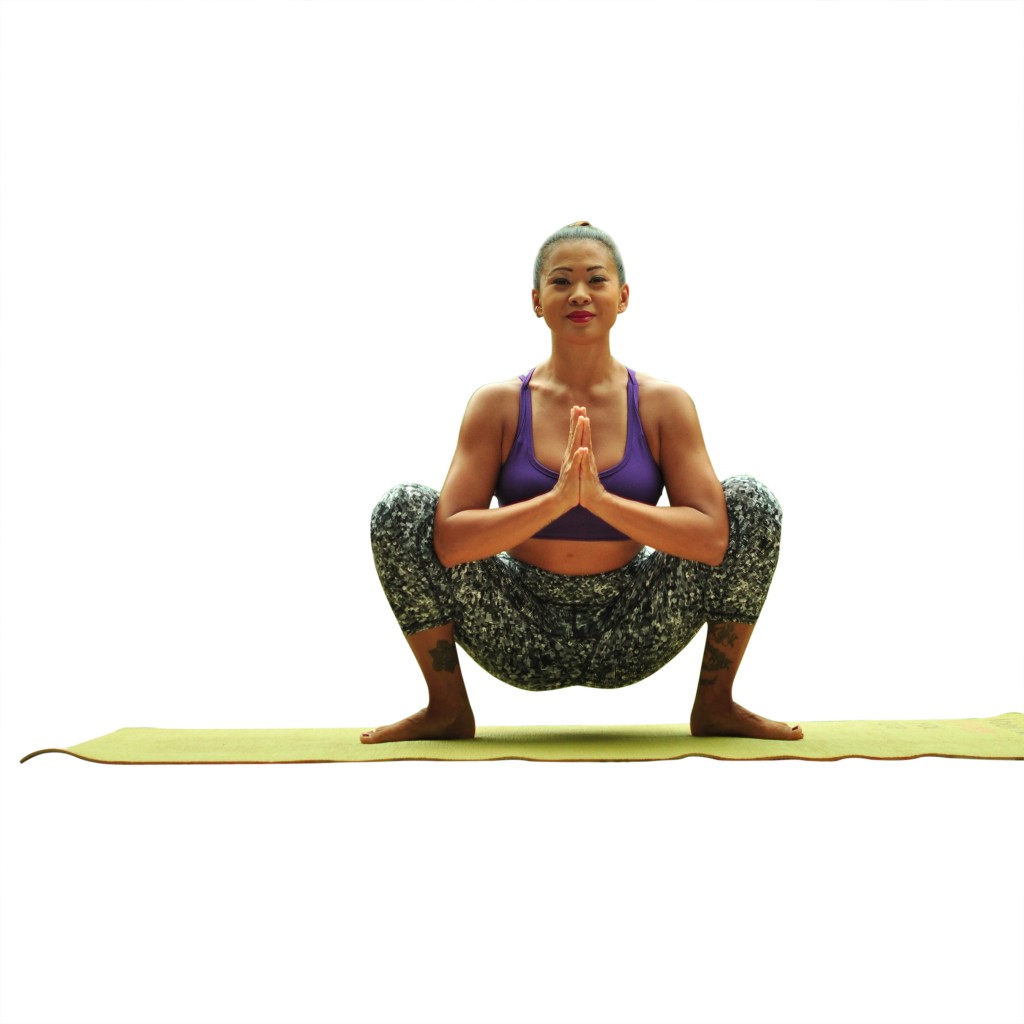
    From Dangle pose, bend your knees and lower your hips into Garland Pose.  Rotate your feet outwards by 45 degrees, and bring the palms of your hands together.  Press your inner thighs back in space with your triceps as you keep your chest lifted.  Hold this pose for five breaths before slowing rising to a standing position.Garland

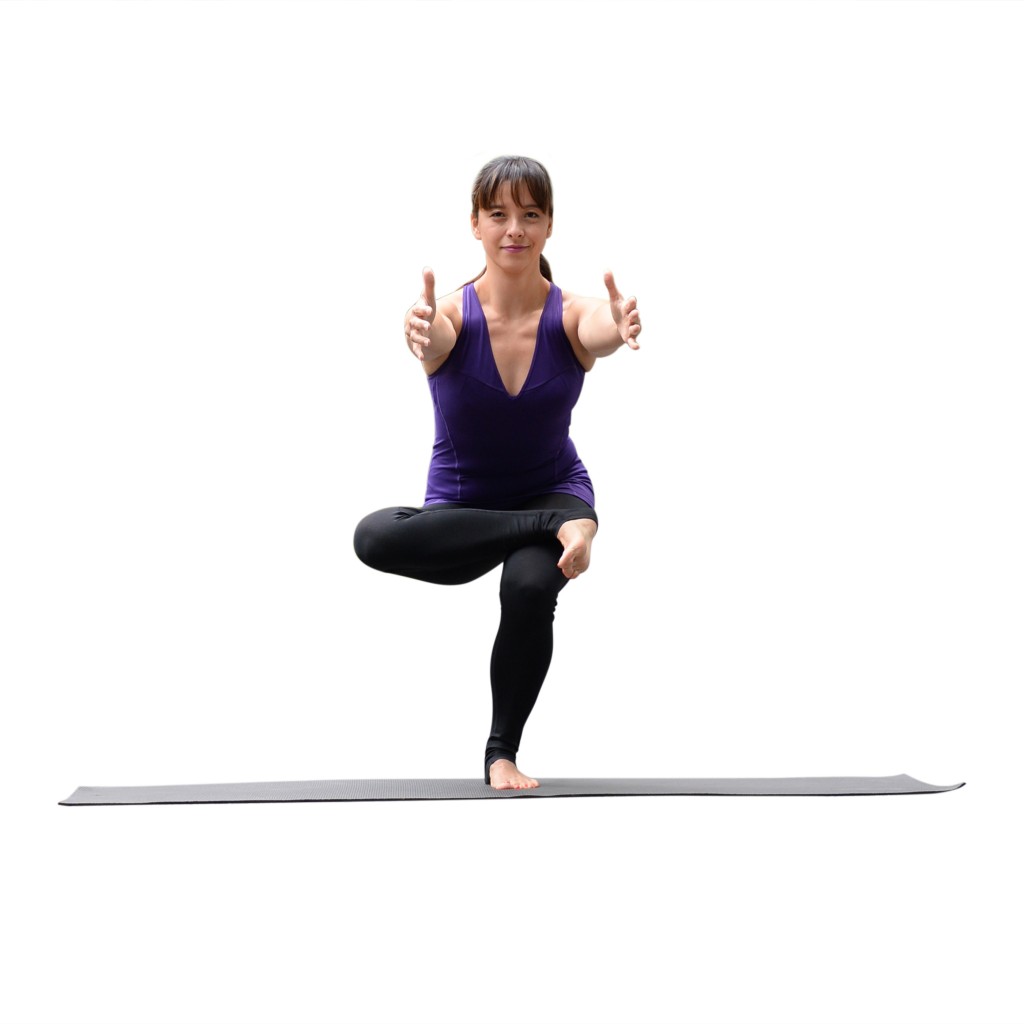
    Flying Pigeon Prep (Eka Pada Galavasana Prep)
    Cross your right ankle over your left thigh, and flex your right foot to activate the your leg muscles and protect the knee. Begin to sink your hips down into a squat, and extend your arms in front of you to help you balance.  You should feel a stretch in your outer right hip as you sink further into the pose.  Hold this hip-opening pose for five breaths before rising back up and repeating on the opposite leg.FlyingPigeonPrep

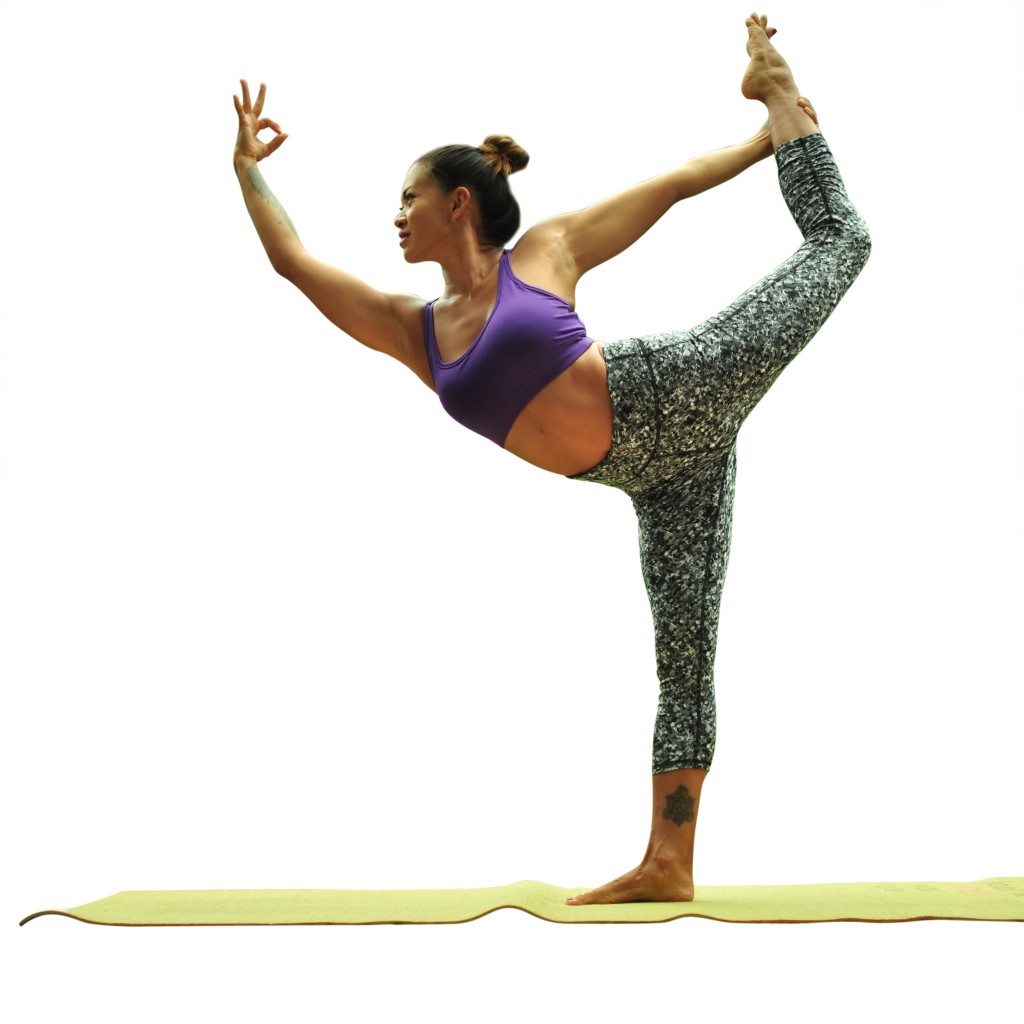
    Lord of the Dance Pose (Natarajasana)
    Stretch your entire front body while strengthening your legs and ankles in this standing balance pose. Focus on a stationary point a few feet in front of you to help find your balance, and kick your foot firmly into your hand to create the tension required to lift the leg higher and hold this posture. Maintain your balance for five breaths, and then practice on the opposite side.LordofDance

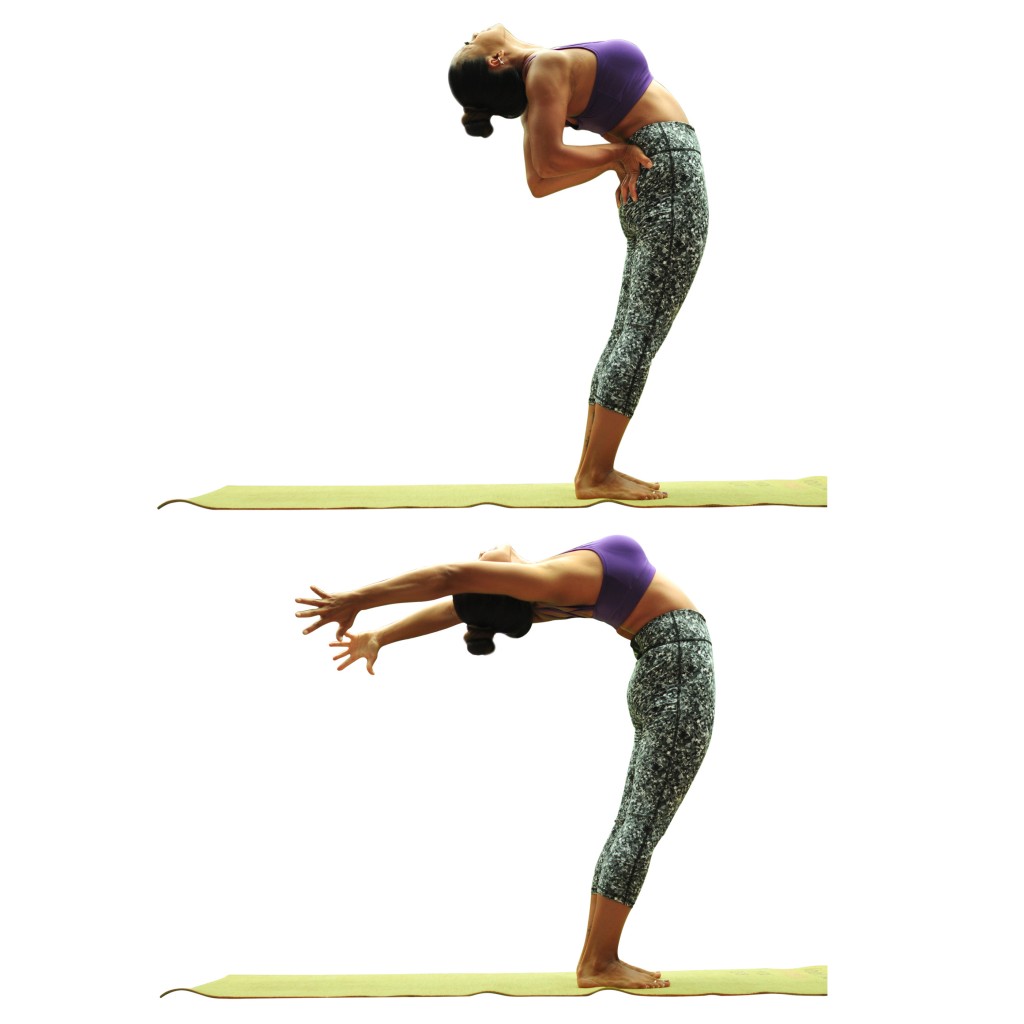
    Standing Backbend (Anuvittasana)
    Choose either of these standing backbends to stretch the chest and reverse the hunching that many of us do throughout the day. In the supported version of this pose, the hands are on the lower back, and in the deeper variation, the hands are actively reaching overhead.  Remember to keep your biceps alongside your ears in the deeper version of this pose to avoid neck strain. Both versions of the backbend will stretch the chest and lengthen the spine to relieve tension.
    StandingBackbend

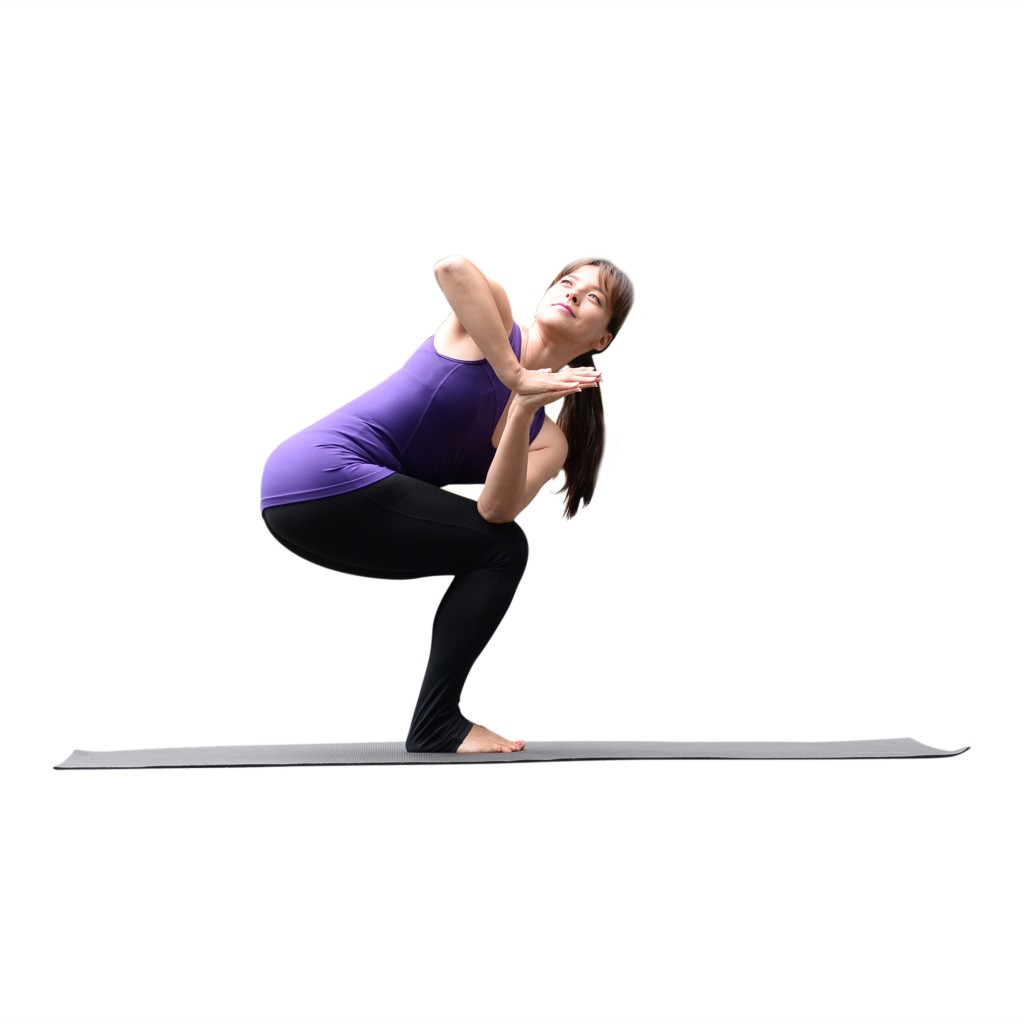
    Revolved Chair Pose (Parivrtta Utkatasana)
    Yoga twists are thought to massage the internal organs, tone the belly and flush toxins from the body. With the possibility of such amazing benefits, we had to include one strengthening twist in the sequence. Press your palms firmly together to gain leverage for a deeper twist. Lift and lengthen your spine with each inhalation and twist deeper with each exhalation. Both knees should be aligned with one another, and your weight should be over your heels, rather than the balls of your feet. Hold this pose for five breaths before twisting to the opposite side.RevolvedChair

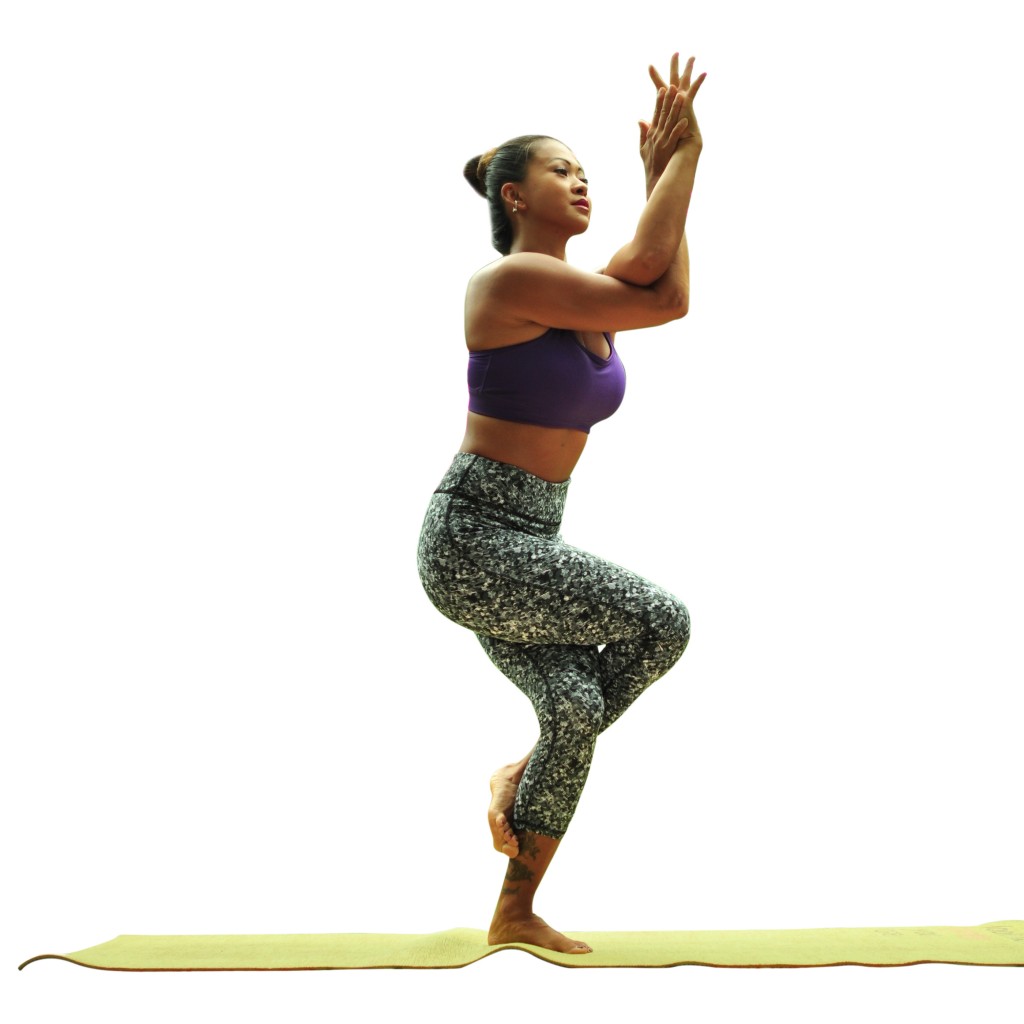
    Eagle Pose (Garudasana)
    This standing balance pose will stretch the upper back and shoulders while challenging your balance and stretching the hips, thighs and ankles. If you have a knee injury or would like a modification, just cross your thighs without adding the element of hooking the raised foot behind the standing-leg calf.  Quick tip:  Remember that your arms and legs are folded in opposite directions!  If your right leg is crossed over your left leg, your left arm is crossed over your right arm.  Hold this pose for five breaths and then practice balancing on the other leg.Eagle

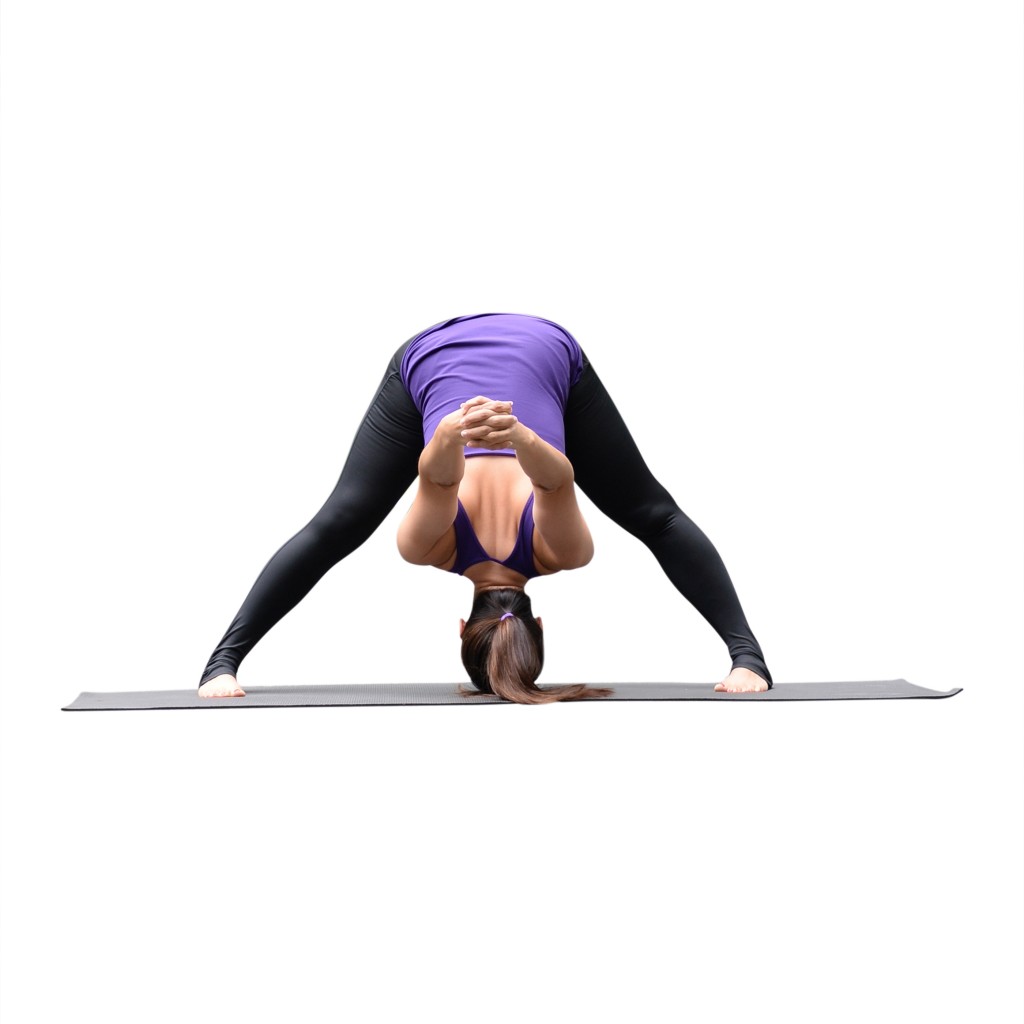
    Wide-Legged Forward Bend (Prasarita Padottanasana C)
    In this variation of a wide-legged forward fold, not only will you stretch your hamstrings, but you will also get a great stretch across your shoulders and chest. Keep your feet parallel as you hinge from the hips, and allow your clasped hands to fall forward for the deepest shoulder and chest stretch. Hold for five breaths before releasing the pose.Prasarita

  • Yoga Challenge with Shape Magazine

    Yoga Challenge with Shape Magazine

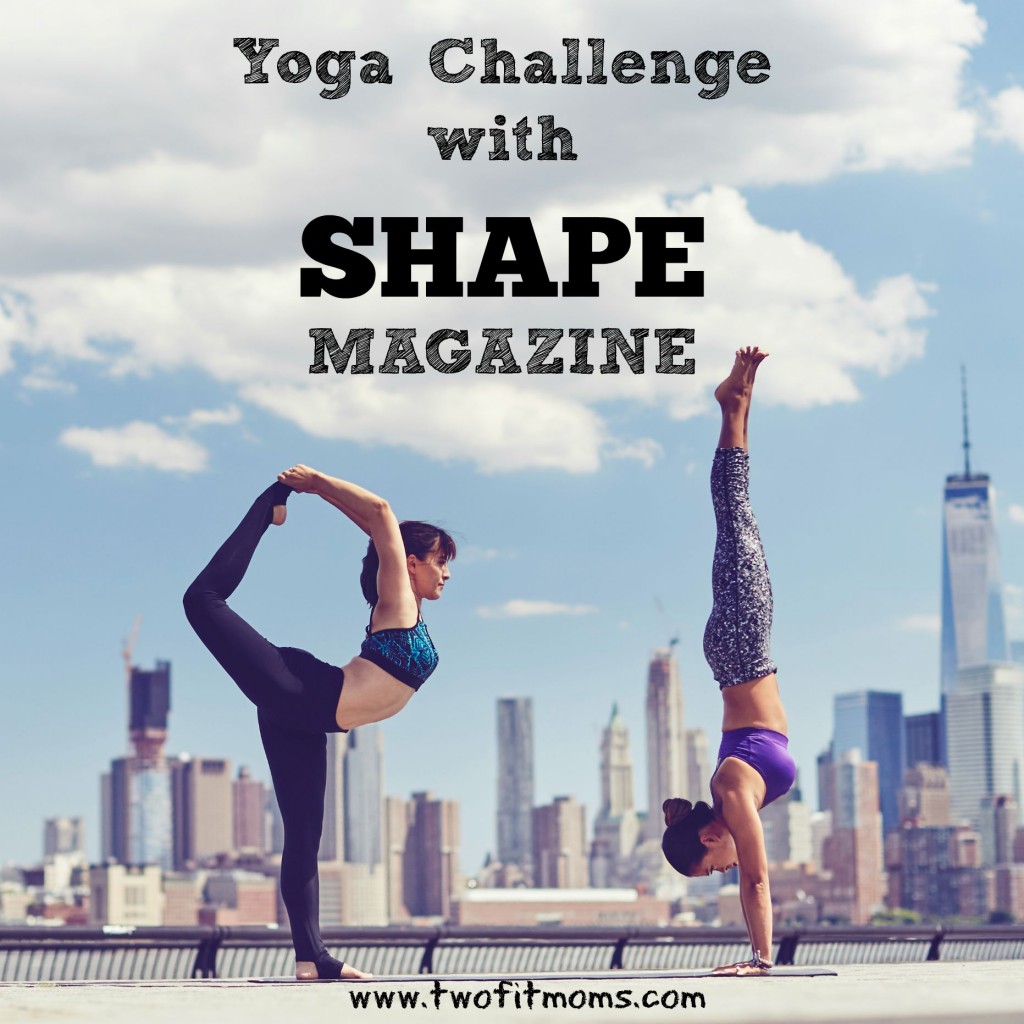
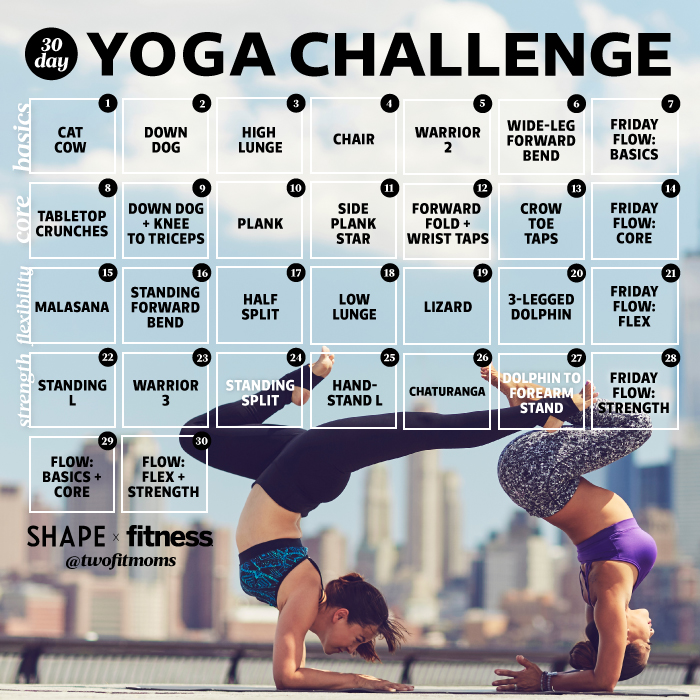
    For the month of August, we are teaming up with Shape Magazine to bring you a daily yoga challenge that is accessible to all levels.  We encourage you to join us and build strength and flexibility. By practicing a single pose each day, you will develop the discipline to hit your mat on a regular basis.YogaChallenge

    Each week, we will be presenting a different theme:

    Week 1:  Basics

    Week 2:  Core

    Week 3:  Flexibility

    Week 4:  Strength

    At the end of each week, you will have six poses that can be pulled together for a short flow that you can practice at home.  For full details, check out the Shape website.  To connect with others, who are also participating in the challenge, post your daily pose on Instagram and use the hashtag #PostYourPose.

    If you are looking for other opportunities to flow with us, download our Yoga Rising classes from Gaiam.  This month, the classes are offered at a special discounted rate!
    Yoga_Challenge_Calendar


  • #1 Tip for Finding Time to Exercise

    #1 Tip for Finding Time to Exercise

    I know it’s a struggle to find time to exercise. It doesn’t seem to matter if you are a new mom or a college student—the day feels like a never-ending cycle of tasks that must get done, and working out doesn’t always cycle to the top of the task list.

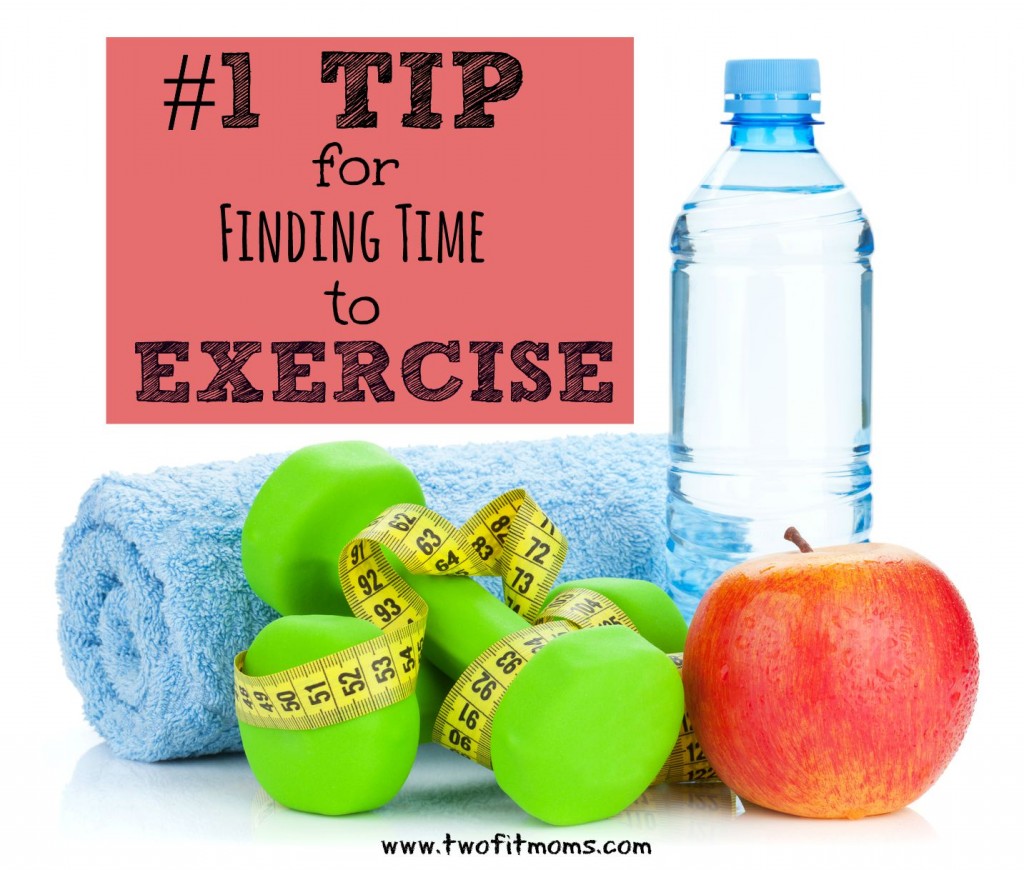
    I have a tip for you that will change the way that you approach exercise. You WILL find time to workout. You might even laugh at the simplicity of this piece of advice, but hear me out. FindingTimeI’ve managed to exercise during periods of my life when I was working 90-hour weeks in an office, and I’ve also managed to exercise when I was a sleep-deprived new mom.

    Here’s my tip for you:

    Find time to exercise by prioritizing your workout above all of your non-negotiable, must-do tasks.

    What do I mean by this?

    Well, we all have a list of items on our to-do lists that MUST get done. Paying bills is a good example. It doesn’t seem to matter how short on time you think you are, you somehow find time to pay the electric bill and the mortgage every month. You also find time to bathe. You find time to buy food and toilet paper. These are examples of non-negotiable tasks.

    If you are a new mom at home and use your baby’s precious naptime to pay bills, your workout will never happen. Before you know it, the baby will be awake. BUT, if you exercise during naptime, not only will you somehow manage to exercise, but you’ll also find that your bills manage to get paid before their due dates, too. It’s a mini miracle. You will find new time that you never realized that you had by squeezing in your workout before doing the must-do tasks.

    This phenomenon reminds me of the tedious process that I used to experience when writing a paper for school.  If I allowed myself a month to work on it, I would use the whole month.  If I only allowed myself a week to work on it, I would get it done in a week.  There was no option to not get it done, and I seemed to work with whatever amount of time I had, even if it was a minimal block of time.  Fitting exercise into my life along with other obligations works the same way.  Even if I think I’m too busy to exercise, if I just go ahead and do it, all of the other necessary tasks in my life still manage to get done.

    Besides the obvious human needs that we all have, non-negotiable tasks will vary from person to person. You need to determine what your must-do list is, and whatever it is, place exercise ahead of the items on that list.

    The reason why you are not squeezing in a workout as it stands right now is because you do not consider exercise to be a non-negotiable activity. Make it one. In the beginning, your workout may only be 15 minutes long because your life is so busy. Who cares? Build the habit today. If you build the habit now, you will automatically increase the length of your workout when your schedule allows for it. Right now, 15 minutes may be as good as it gets, and that’s just fine. Commit to a program, even if it’s brief, and fit it into your life like a non-negotiable meeting.


  • Understanding Your Eating Style

    Understanding Your Eating Style

    Most mornings, I wake up and make a smoothie for my kids. It sounds like a simple and quick breakfast, but in my house, nothing is that simple. My kids don’t consider a smoothie to be a meal. Once I hand them their smoothies, they ask me what else I’m making.

    The smoothie, in their minds, is just a drink—an accompaniment to their meal, and not a meal on its own. So, each morning, I make smoothies along with scrambled eggs or pancakes or something else that they consider to be a real meal.EatingStyle

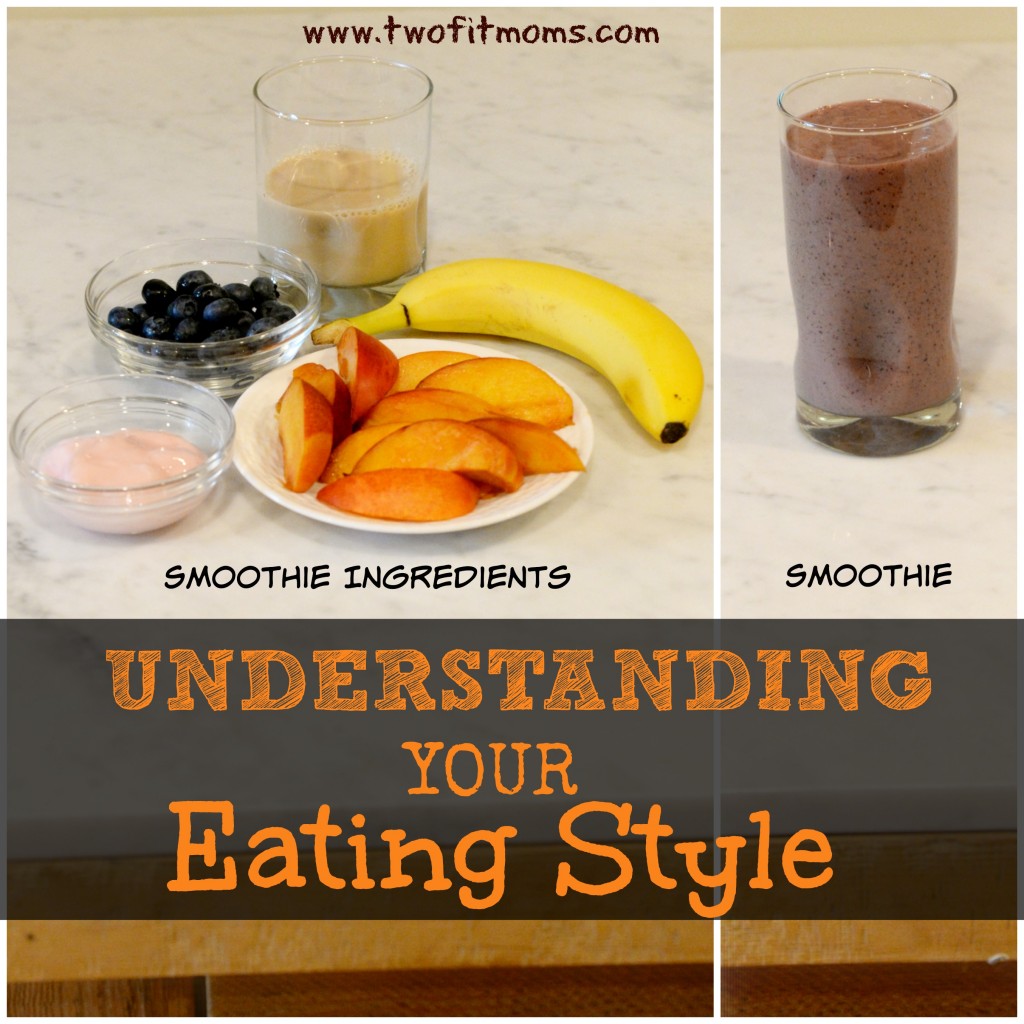
    BUT, if I placed all of the smoothie ingredients onto the table and announced that breakfast was served, I bet that my kids would laugh in disbelief at the quantity of food before them. Look at the ingredients in this morning’s smoothie: nut milk, blueberries, a whole banana, a whole peach, and a quarter cup of strawberry yogurt. They would say that they couldn’t eat all of that food in one sitting. It doesn’t cross their minds that they DO eat all of that food in one sitting (in addition to the “real” meal that I’ve prepared).

    This got me thinking…

    How many adults go through the motions of either buying a smoothie or blending one at home each day without any appreciation for the significant quantity of food that they are consuming? Perhaps some adults realize it. My husband happens to be one of those people, which is why you’ll never see him eating plates of fruit and yogurt and milk. He’s not a big breakfast eater, and the thought of eating plates of food first thing in the morning is just too much for him. A smoothie, which hides all of the bulky volume of fruit, is a perfect solution for someone like him, who would otherwise not eat breakfast at all. He knows he’s getting all of the benefits of fruits, vegetables, nut butters, etc., without actually having to sit down and eat all of that food with utensils.

    I happen to be on the other end of the spectrum. If I choose to drink a smoothie for breakfast, I am looking for snacks within an hour, even if I’m not actually hungry. I am like my children, and my brain interprets the smoothie as a drink, not a meal. I would much rather see an abundant breakfast in front of me—a breakfast that I can chew and savor, rather than gulp down. I don’t care about the convenience of having a smoothie in a cup that can travel from the home to the car. I’d much rather sit down with multiple plates and bowls of food to taste. Eating the individual ingredients of the smoothie would be a much more satisfying experience than drinking the blended version of those same ingredients.

    If you are working towards healthier eating habits, it’s SO important to understand your thought processes surrounding food so that you can tailor your meals and snacks to complement your tendencies.

    Eating mindfully is key.

    If you are wondering whether smoothies are a good breakfast option, ask yourself these questions:

    -Am I a volume eater? Do I like having lots of food in front of me?

    -Do I need various textures of food to feel satisfied?

    -Can I be satisfied with a liquid meal?

    -Am I better off eating the unblended ingredients of a smoothie in whole form? Do I prefer liquid meals? If so, why? Does convenience and portability have anything to do with my preference for smoothies?

    If you answer each of these questions and really consider how and why you think the way you do, you can begin to understand why you eat the way you do. Once you get a handle on why you eat the way you do, you will become more mindful of your food choices and begin to develop healthier eating habits.

    In the past, I’ve touched upon the subject of different eating habits. Not everyone has the same approach to eating, and that’s okay. Just becoming more mindful of your own approach and your own inclinations can help you figure out how to create healthy habits that will work for you.


  • Why Naked is Better

    Why Naked is Better

    A few years ago, I had a fabulous pink bikini that fit well and felt great. Yesterday, I put that same bathing suit on, and I noticed that my skin bulged around the elastic. I felt lumpy and bumpy and became quite critical of myself as I stared at my reflection in the bathroom mirror.

    Here’s an interesting point— I don’t remember the last time I passed judgment on my naked body. I only began judging my body yesterday afternoon when it was clothed in a swimsuit. Without the constraints of clothing, there was no pinching or squeezing or reason to doubt myself. It was only when I shifted the framework and added the constraint of clothing that my thoughts became negative.

    This got me thinking—How freeing it would be to just enjoy the stripped down version of EVERYTHING in life—without a framework for comparison.

    Think about it: You feel good about your accomplishments…until you shift your framework and begin comparing those accomplishments to someone else’s. You feel great about your morning run…until you realize that it took you four minutes longer to run the same route that you ran last week. You feel great about your body until you try to squeeze it into skinny jeans. If only we could always just enjoy life as it hits us, in its raw, naked form, without judgment, WE WOULD BE FREE!

    Here are some tips to free yourself:

    -Life is too short for ill-fitting clothes that make you feel like crap. Have you gained a few pounds? Fine. It happens, and you’ll deal with it, but there’s no reason to walk around feeling self-conscious. You should feel confident because you are worthy. Buy a few items that fit well and make you feel like the rock star that you are.

    -Try going for a run, going for a bike ride, or doing whatever it is that you like to do as part of your fitness regimen, and do it without timing yourself. Jog until you don’t feel like it anymore. Slow down if you want to. Speed up if that feels good. Lift some weights without counting reps. Elevate your heart rate for as long as it feels invigorating, and then stop. Of course you should challenge yourself and set goals, but once in a while, strip it down to the basics: Enjoy moving your body just because you can.

    “Keep your eyes on your own paper.” Did every elementary school teacher say that before a test? At the end of the day, when you glance at someone else’s work, you just end up cheating yourself. Stop comparing. Your life experience is yours and no one else’s. Don’t take the joy and pride out of your accomplishments because the guy next to you seems to have done more.

    Practice yoga in solitude. This idea is an extension of the “keep-your-eyes-on-your-own-paper” theme. The energy of a yoga class is amazing, and you shouldn’t give it up, but too often, we are distracted by the abilities of those around us. We begin to judge our own yoga skills and wonder if we are strong enough or flexible enough to keep up. By practicing alone, you will learn to keep your eyes on your own mat and build a practice that you love, without negative judgement.


  • Overcoming Perfectionism

    Overcoming Perfectionism

    Today, I looked out the window and decided that it was going to rain. And then the sun came out, and I decided that it wasn’t going to rain anymore. And then it rained again. And then it stopped. And then it started again. (It’s actually a bit humorous, now that I’m re-reading what I’ve typed here.)

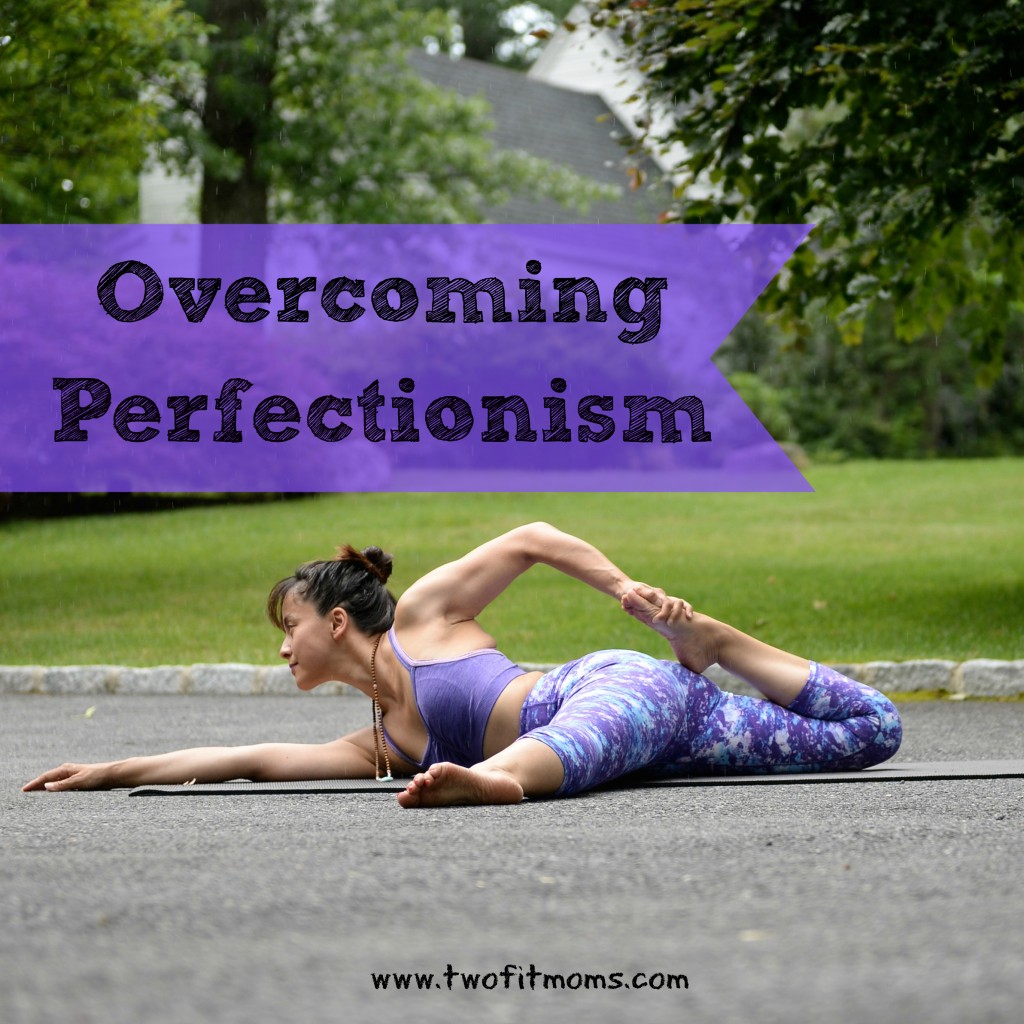
    I stuck my head out the front door to check the temperature. It was hot and humid…typical summer weather in New Jersey, and perfect for stretching and yoga. I briefly considered going outside to practice in the heat, but I changed my mind when I looked up at the sky and saw dark clouds. Conditions weren’t perfect, and I could imagine slipping on my mat in the rain, and hurting myself. Who needs an injury on top of the searing pain that I already have in multiple joints?OvercomingPerfectionism

    I looked outside again. The sun was shining and the rain stopped. This was getting absurd. This time, I decided to head out to my driveway to practice. I started with a few rounds of sun salutations, some hamstring openers, a quick flow, and then I rolled onto my side, and got into one of my favorite yin yoga poses (Cat Pulling its Tail Pose), and I settled in for four minutes. Not even 30-seconds into the pose, the sky opened up, and it started to rain. I lifted my head (as you can see in the photo) and looked around. Yes…yes, it was raining. And that was really all I had to say about that. I put my head back down onto my upper arm and continued to stretch. The world was not ending, and I got through my practice in the rain.

    So, what does this story have to do with you? Well, I’m guessing that I can’t be alone in this— I waste vast amounts of time, waiting for conditions to be perfect before taking action. I am reminded today that conditions don’t have to be perfect to take action. It’s so easy to get bogged down and remain stagnant while waiting for all of the right circumstances to fall into place.

    Stop waiting for conditions to be perfect!

    Stop placing expectations on how things SHOULD be.

    Learn to act today, embracing what IS.

    You can thrive in the current environment, and you don’t have to wait another minute, waiting for the stars to align.

    Today, I expended unnecessary mental energy, trying to decide whether I should practice outside. All along, the answer was yes, I should practice outside, and once I’m out there, I’ll know how to adjust my plan if necessary. No, it wasn’t perfect, but I got something done.

    Ask yourself if you’re holding yourself back in some part of your life because you are waiting for perfection.


    -When it comes to your diet, are you giving up on healthy eating for the rest of the day because you “messed up” at breakfast and ate three doughnuts? Are you waiting for tomorrow to start over because you need a clean slate? Why do you need to wait for conditions to be perfect? Can you overcome your desire for perfection and just get started right now?

    -When it comes to exercise, are you skipping it altogether because you only have 15 minutes? Have you convinced yourself that a full hour is the ideal workout length, and 15 minutes isn’t worth your while? Ask yourself why you need this perfect amount of time to workout. Can’t you begin to make a difference in your life with 15 minutes a day?


    Life is rarely perfect. Usually, I allocate a solid block of time to write for this website. I don’t whip up my articles in 30 minutes, so if I happen to be very busy or traveling, the articles don’t happen. I spend a ridiculous amount of time trying to convey my thoughts with the right words. The perfect words.

    Today, I don’t have that kind of time to spend on the website, but in the spirit of overcoming my own issues with perfectionism, I’m going to go ahead and post this piece in its rough, unedited form.

    I had two choices when I came inside out of the rain: I could quickly type up these thoughts and share them with you (even though the article is far from perfect), or I could skip writing altogether. In the end, I’m glad I chose to write.

  • Struggle Management

    Struggle Management

    I have been very public about my own wellness journey and the struggles that I have encountered along the way. I’ve posted articles about my diet, my meditation practice, my first experience with acupuncture, and all sorts of other topics that relate to my health. I’ve even posted a bunch of tips to consider after being diagnosed with an illness. What I haven’t done is discuss how I’ve dealt with the emotional toll of being diagnosed with a medical condition. It’s a disconcerting and frightening time, especially at the beginning. Even the most level-headed person can fall into the trap of imagining worst case scenarios and horrific outcomes. It’s not a good place to be. It is far better to be in a place of hope and positivity, and that is the goal—to make your way to an emotionally comfortable place following a medical diagnosis or any kind of life struggle.StruggleManagement

    Your struggle may not be an illness— Maybe you’ve lost your job, or maybe you work three jobs as a single parent to make ends meet. Maybe you’re caring for a sick relative, or maybe you’re overwhelmed at work or stuck in a job that you dislike. Whatever your struggle is, I’m confident that you can manage your way through the muck and live a fulfilling life that feels purposeful and worthwhile.

    Here are my top tips for helping you navigate the choppy waters. This is how I’ve dealt with all of the major struggles that I’ve faced in life, and I hope you can find inspiration here to continue moving forward.


    1. Determine what good can arise from the situation. This is a tough one, but I believe it’s a necessary step in overcoming any challenging circumstance. You might have been dealt a terrible hand, but you need to play it. Your situation may be painful and seem insurmountable right now. It might be difficult to imagine anything good coming out of the struggle, but try to make a list. Can there be any purpose in the pain? Will this struggle help you prioritize what is truly important in life? Will you live each day with more clarity and purpose because you are being faced with this struggle? Will you be able to advocate for others with a strong voice as a result of facing this situation yourself? Will your struggle force you to slow down and find beauty in simple everyday acts? Will you overhaul destructive habits and adopt a healthier lifestyle as a result of your struggle? Will you help your family become stronger as a result of them witnessing your strength during this trying time? Make a list, and see that goodness can flow right out of a not-so-good situation.


    1. Maintain a positive attitude. This tip goes hand-in-hand with the previous tip. You must change your thinking. Once you can find purpose in your struggle, or at least something positive that might arise as a result of your struggle, it becomes easier to stay upbeat. Yes, you need to mourn whatever it is that you’ve lost (your good health, a family member, your life savings, your job, etc), but you can’t stay in a deep dark place forever. You have a choice to send positive energy or negative energy out into the world, and I know that you can keep it positive. Remind yourself often that you are strong and capable. Remind yourself that the mind is a powerful tool. You can convince yourself that you are too tired and too weak to overcome your circumstance or you can create a positive environment and talk yourself right into a better mindset where you feel empowered. The choice is yours, and it is up to you to make the right choice.


    1. Take control of your health. There is so much that we cannot control about our health, but fortunately, there is a tremendous amount that we can control. Don’t allow a medical diagnosis to crush your spirit. Don’t give up on your body. Do some research and get inspired by natural remedies and foods that can help you feel better. Regardless of the nature of your current life struggle, you can change your diet, implement a daily exercise program, and begin a regular meditation practice to lower stress levels. You can reduce systemic inflammation, boost your immune system, strengthen your bones and muscles, improve the quality of your skin, and generally feel much better than you’d otherwise feel if you gave no thought to your health habits. Get on the wellness bandwagon. You won’t regret it.


    1. Help someone else. When you hit rock bottom, it’s hard to think about helping someone else. After all, how can you help someone else if you can barely figure out how to help yourself? I understand, and I get it. But I also know that the tendency during a personal struggle is to focus on me, me, me. Yes, it’s warranted, but it’s also healthy to focus on something else that is worthwhile, and something that will also give you a greater perspective on life. Maybe you won’t have the time to volunteer at the local shelter or organize a fundraiser, and that’s ok… but you’re not off the hook. Figure out another way to be of service to someone else. This may be as simple as joining a support group and sharing your experience with someone else going through the same struggle. Sharing your experience and providing your own unique perspective can be inspiring and helpful to someone else.


    1. Sleep. What can I say? I didn’t believe it for a long time, but a good night of sleep can do a lot to transform your state of mind. Feeling blue? Exhausted? Too overwhelmed to even call a friend? Go to bed, and make sure to get plenty of rest. Healing on many levels occurs overnight. It will all seem a bit more manageable in the morning.